
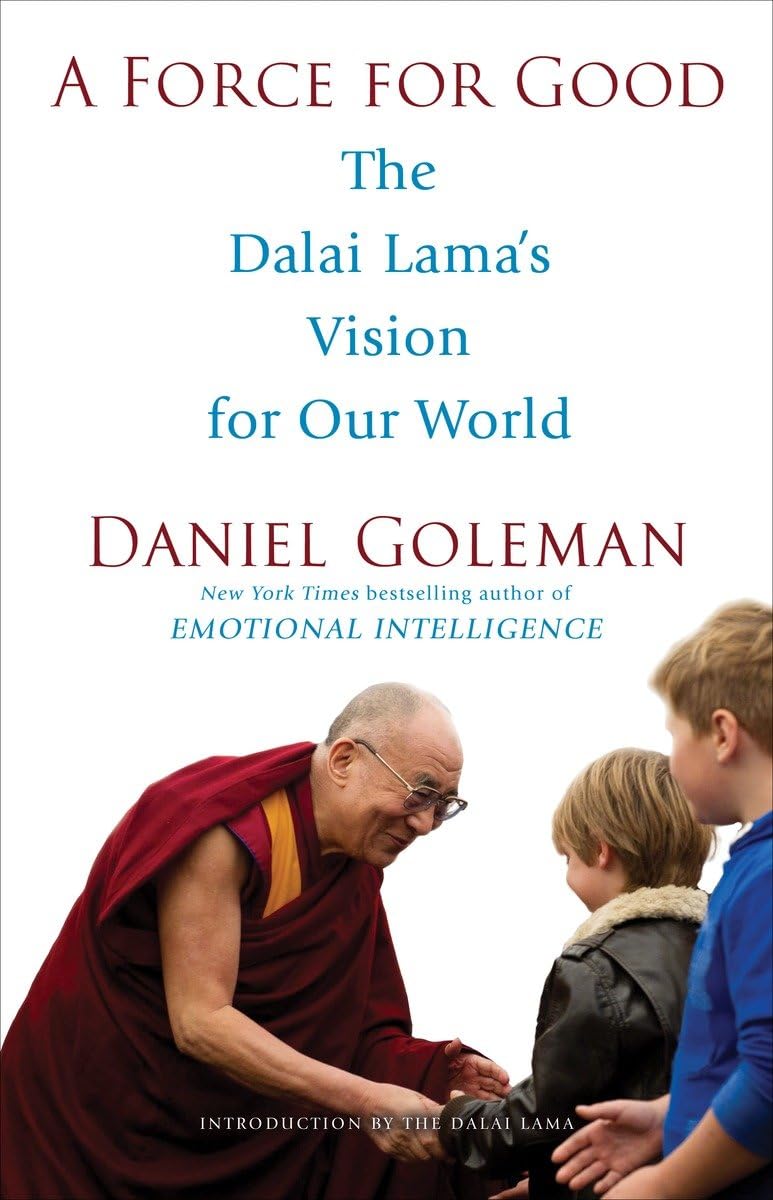
A Force for Good Summary
By Daniel Goleman
The Dalai Lama's Vision for Humanity
Summary preview
What kind of power can truly change the world for the better? That is the living question running through A Force for Good. At first glance, you might expect a book about religion, or about one remarkable spiritual leader, or about the history of Tibet and its tragedy. All of that appears here. But the real heartbeat of the book is larger and more practical. It asks how a human being can meet a troubled world without hatred, how ancient wisdom can help with very modern crises, and how compassion can become something active, intelligent, and effective. Daniel Goleman brings us close to the mind and method of the Dalai Lama, not by offering a simple biography, but by showing how his vision has evolved over decades. We see a man formed by Buddhist practice, sharpened by exile, tested by political catastrophe, and yet never trapped by bitterness. Instead of retreating into private spirituality, he turns outward. He looks at violence, inequality, environmental destruction, corruption, trauma, prejudice, and the failures of education, and asks what can actually be done. Again and again, his answer begins with the same foundation. The mind matters. Emotions matter. Our shared humanity matters. Inner change and outer change belong together. This is not a dreamy or abstract message. The book is grounded in conversations with scientists, educators, activists, psychologists, business leaders, and peacemakers. It shows how compassion can be studied, trained, and built into institutions. It explores how destructive emotions cloud judgment and fuel conflict. It looks at systems that reward greed and short term thinking, then asks how ethics can move beyond religion into a universal framework based on human well being. What emerges is a bold idea. Goodness is not weakness. Compassion is not passivity. A calm and caring mind can be a force with real social power. As the story unfolds, you feel the expansion of one person’s concern from his own people to the whole planet. The suffering of Tibet remains deeply important, but the lens widens. The fate of humanity is linked across borders. We breathe the same air, warm the same climate, inherit the same wounds, and shape the same future. The book keeps returning to a simple but demanding insight. Since we are interdependent, the old habit of us and them no longer works. If we want peace, health, justice, and survival itself, we have to learn how to care beyond tribe, beyond ideology, beyond immediate self interest. That is the invitation waiting here. Not to admire goodness from a distance, but to understand how it works, how it grows, and how it can be practiced in daily life and public life alike.
Sign up to continue reading
Get access to full book summaries, audio of the summaries, and many more.
Similar Books
Books with a similar vibe—explore more like this.

Sovereign Self
Acharya Shunya
Claim Your Inner Joy and Freedom with the Empowering Wisdom of the Vedas, Upanishads, and Bhagavad Gita
4.8 (114)24 mins

The Book of Five Rings
Miyamoto Musashi
A Classic Text on the Japanese Way of the Sword
4.7 (293)23 mins

Uncle Tom's Cabin
Harriet Beecher Stowe
The Problem of Slavery and Its Treatment of Human Beings
4.7 (41)25 mins

The Divine Comedy
Dante Alighieri
The Inferno, The Purgatorio, and The Paradiso
4.6 (457)27 mins

The Power Of Meaning
Emily Esfahani Smith
Crafting a Life That Matters
4.6 (126)27 mins

The Book of Genesis
The Holy Bible
In the beginning
4.6 (12)30 mins

The Book
Alan W. Watts
On the Taboo Against Knowing Who You Are
4.5 (540)26 mins

The Book of Joy
Dalai Lama & Desmond Tutu
Lasting Happiness in a Changing World
4.5 (1523)35 mins

The Way of Zen
Alan W. Watts
The history and core principles of the Eastern philosophy of Zen
4.4 (756)32 mins
The Road Less Traveled
M. Scott Peck
A New Psychology of Love, Traditional Values and Spiritual Growth
4.4 (1249)22 mins