
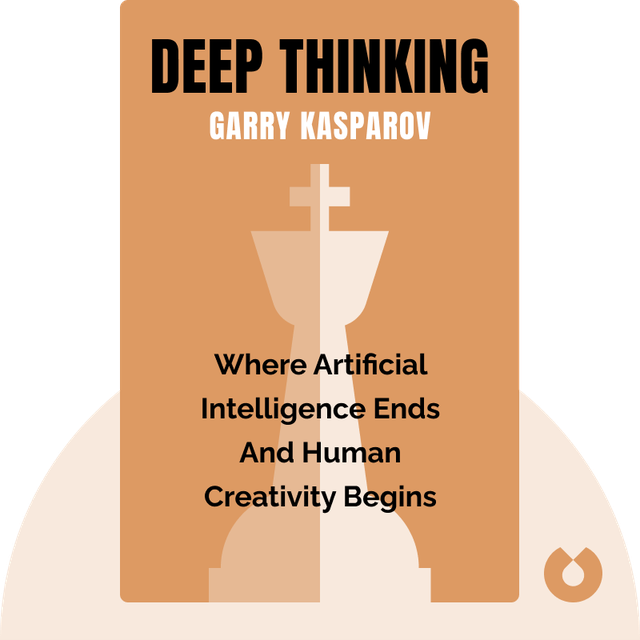
Deep Thinking Summary
By Garry Kasparov
Where Artificial Intelligence Ends and Human Creativity Begins
Summary preview
Deep Thinking is a book about a rivalry that became much bigger than chess. On the surface, it tells the story of world champion Garry Kasparov facing IBM’s machine Deep Blue in two famous matches, first in 1996 and then in 1997. But the real subject is what happens when human intelligence meets machine intelligence, not in science fiction, but in real life, with all the pride, fear, ambition, confusion, and possibility that come with it. What makes this book special is that it does not speak about technology from a distance. It comes from the middle of the storm. Garry Kasparov was not just a commentator watching change happen. He was one of the first people to feel, in a deeply personal way, what it means to confront a machine that can challenge a great human mind at its own game. Chess became the testing ground, but the lessons reach far beyond sixty four squares. They touch business, creativity, work, politics, education, and the future of decision making itself. The story begins with a belief many people shared for a long time, that chess was a perfect measure of human thought. If a machine could play chess like a master, perhaps it could think. If it could defeat the best human in the world, perhaps a line had been crossed. Yet the book pushes us to be more careful. A machine does not think like we do. It calculates, it searches, it processes. Humans use intuition, memory, pattern recognition, emotion, imagination, and purpose. The contest matters not because it proves machines are becoming human, but because it shows how different kinds of intelligence can collide and combine. Running through the book is a stubborn optimism. There is no denial that technology can be disruptive, unfairly distributed, or dangerously powerful. There is no attempt to hide the pain of losing to Deep Blue, or the frustration over how the match was handled. Still, the larger message is not one of defeat. It is a call to adapt. The future, the book argues, belongs not to humans alone or machines alone, but to humans working with machines. The strongest force is not artificial intelligence replacing us. It is enhanced intelligence helping us do more than we could do on our own. So this is part memoir, part history, part warning, and part invitation. It asks us to stop treating technology as either a monster or a miracle. Instead, we should understand it, shape it, and use it. If we do, then the lesson of the chessboard is not that humans are finished. It is that we have entered a new era, one where our greatest advantage may be our ability to invent tools that challenge us, teach us, and ultimately make us better.
Sign up to continue reading
Get access to full book summaries, audio of the summaries, and many more.
Similar Books
Books with a similar vibe—explore more like this.
The Human Edge
Greg Orme
How Curiosity And Creativity Are Your Superpowers In The Digital Economy
4.6 (595)26 mins
Tomorrow, and Tomorrow, and Tomorrow
Gabrielle Zevin
A Novel
4.5 (4281)24 mins
The Creativity Code
Marcus du Sautoy
How AI is learning to write, paint and think
4.5 (1038)36 mins
The Innovator's Dilemma
Clayton Christensen
When New Technologies Cause Great Firms to Fail
4.4 (829)20 mins
The Hitchhiker's Guide to the Galaxy
Douglas Adams
A Novel
4.4 (81)22 mins
Deep Future
Pablos Holman
Creating Technology That Matters
4.4 (41)22 mins

Tomorrow and tomorrow and tomorrow
Gabrielle Zevin
A Novel
3.5 (11)22 mins
Building Your Money Machine with ChatGPT
Larry Wheeler
Use AI to Generate Ideas, Automate Marketing, and Build Profits
3.2 (124)21 mins

L&D's Playbook for the Digital Age
Brandon Carson
Transform learning into a growth engine for the digital workplace.
3.1 (5)22 mins
Nineteen Eighty-Four (1984)
George Orwell
A Dystopian Classic on the Dangers of Totalitarianism
4.9 (697)17 mins