
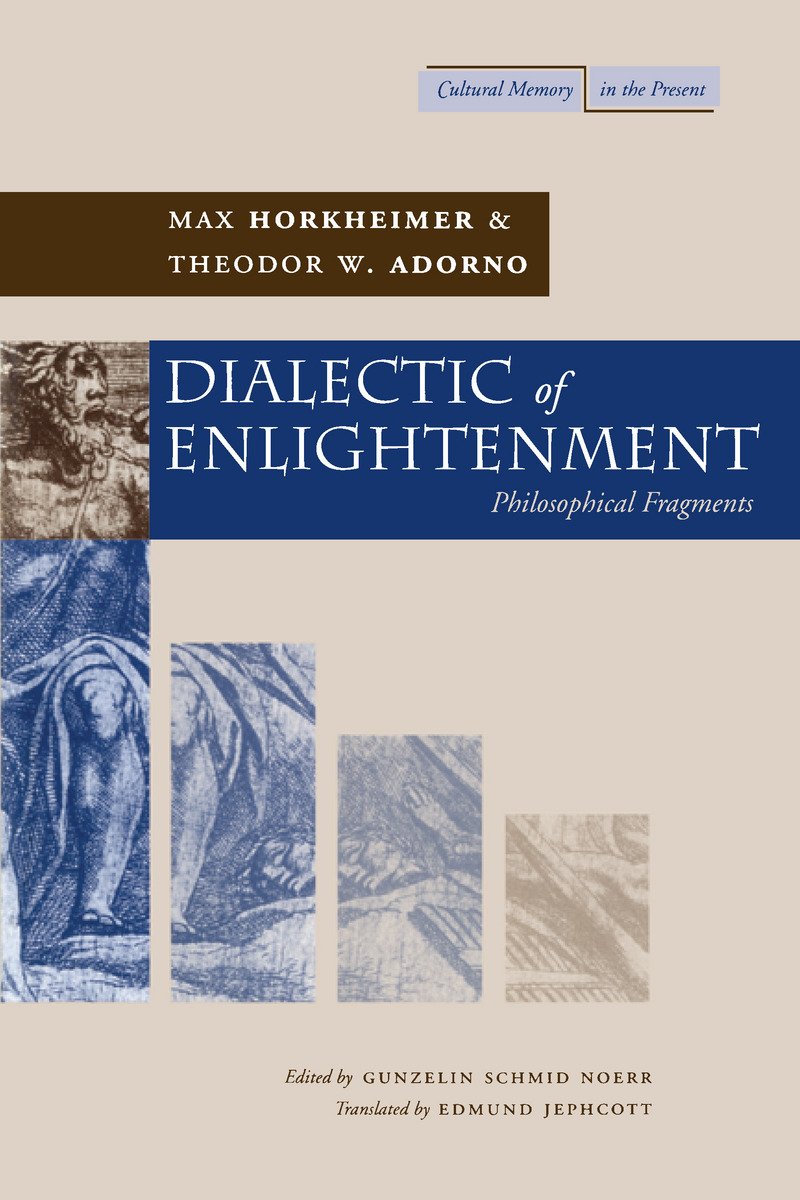
Dialectic of Enlightenment Summary
By Max Horkheimer & Theodor W. Adorno
Uncover the Paradoxes of Modernity and Reason
Summary preview
You open this book expecting a defense of reason, perhaps even a celebration of the great modern promise that knowledge would free human beings from fear, myth, and domination. Instead, you are brought into a darker landscape. Here the very power that was supposed to liberate us has turned back on us. Enlightenment, we are told, has always aimed to "disenchant the world," to strip things of mystery and bring everything under calculation. Yet the bitter twist is that this victory over myth does not simply create freedom. It can also create a new kind of blindness, one that treats people, nature, and thought itself as things to be managed, classified, and used. That is the pulse running through Dialectic of Enlightenment by Max Horkheimer & Theodor W. Adorno. The book was written in the shadow of fascism, war, exile, and the collapse of the very civilization that had boasted most loudly about progress. Its question is urgent and painful. How could a world that produced science, philosophy, constitutional government, and technical mastery also produce concentration camps, mass deception, and industrialized destruction? The answer is not that reason failed because there was too little of it. The answer is more unsettling. A certain kind of reason succeeded too well. Instrumental reason, reason reduced to control and utility, came to dominate everything else. You are not given a neat system or a calm march of arguments. You are led through fragments, sharp reversals, old myths, modern entertainment, anti Semitic paranoia, and philosophical reflections that circle around the same wound. The book moves by showing how opposites secretly belong together. Myth already contains enlightenment because myth tries to explain and master the unknown. Enlightenment falls back into myth when it becomes rigid, automatic, and self worshiping. Freedom turns into conformity. Individuality turns into mass production. Pleasure turns into discipline. Culture turns into industry. What makes the book so gripping is that it never lets you rest in easy innocence. The problem is not just dictators, propagandists, or reactionaries somewhere out there. The habits of domination are built into ordinary ways of thinking. Whenever thought asks only how to classify, predict, and exploit, it helps prepare a world where human beings are reduced to functions. For instance, nature becomes raw material, art becomes merchandise, and even happiness gets packaged as a product. So the purpose here is not to reject reason altogether. It is to rescue reason from its own self mutilation. The book wants to remember a form of thought that can reflect on itself, resist blind power, and keep alive what does not fit the system. It is a warning, but also a plea. If enlightenment is to deserve its name, it must learn to face the domination hidden inside its own triumphs.
Sign up to continue reading
Get access to full book summaries, audio of the summaries, and many more.
Similar Books
Books with a similar vibe—explore more like this.
Utilitarianism
John Stuart Mill
Explore a Timeless Ethics Classic
4.8 (46)24 mins
The Metaphysics
Aristotle
Dive into Ancient Philosophical Insights
4.4 (17)17 mins

Compromised
Peter Strzok
Counterintelligence and the Threat of Donald J. Trump
4.0 (18)35 mins
Indian Philosophy
Sue Hamilton
A Very Short Introduction
3.9 (7)22 mins

The Song of Roland
Anonymous
Enter a World of Medieval Heroism, Where Honor Reigns Supreme
4.9 (3)20 mins

Hamlet
William Shakespeare
A Young Prince's Tragic Descend Into Madness and Revenge
4.8 (43)28 mins
The Epic of Gilgamesh
Anonymous
A timeless tale of friendship, mortality, and the search for meaning
4.8 (34)23 mins
The Midnight Library
Matt Haig
A Fantasy Novel About the Choices That Lead to a Life Well-Lived
4.7 (4782)32 mins
Uncle Tom's Cabin
Harriet Beecher Stowe
The Problem of Slavery and Its Treatment of Human Beings
4.7 (41)25 mins
Bedtime Biography: Isaac Newton
James Gleick
Learn the truth behind the legend
4.7 (45)21 mins