
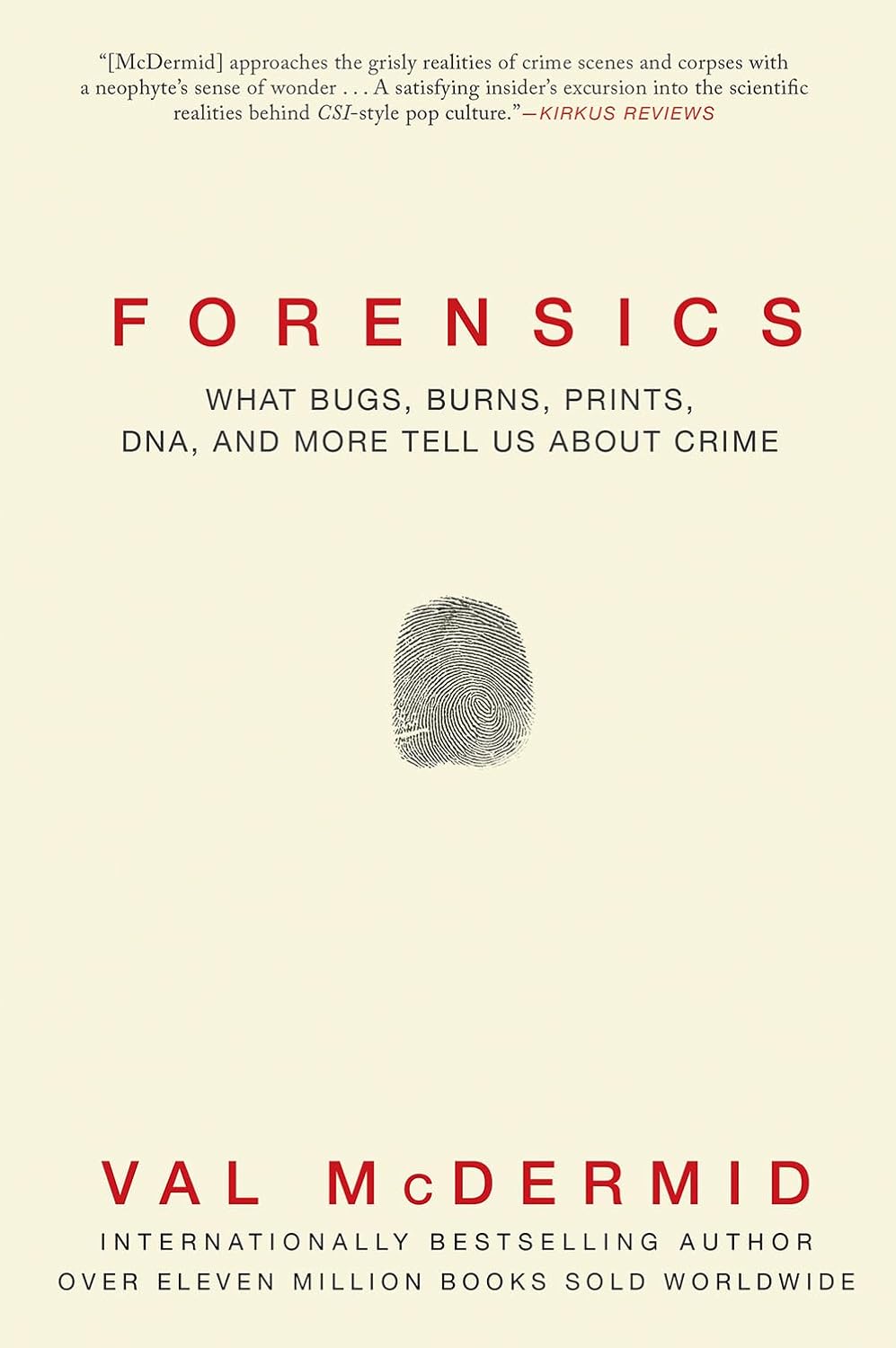
Forensics Summary
By Val McDermid
What Bugs, Burns, Prints, DNA, and More Tell Us About Crime
Summary preview
Crime leaves traces. That is the simple promise at the heart of Forensics, and also the reason this book is so hard to resist. It opens a door into a world most of us know only through headlines, court reports, and television dramas, then gently but firmly shows us what the real work looks like. It is not magic. It is not one lone genius squinting at a clue and solving everything before the ad break. It is painstaking, collaborative, often messy work, carried out by people who must be part scientist, part historian, part detective, and part witness for the dead. Val McDermid takes you by the hand and leads you through that world with the ease of someone who has spent years thinking about crime and the stories we tell around it. The book is built around the major branches of forensic science, from the first glance at a crime scene to the hidden messages stored in a computer hard drive. Along the way, it asks a deeper question. How did we learn to read the body, the bloodstain, the fingerprint, the strand of hair, the fleck of soil, the digital trace? And just as important, how much faith should we place in what those traces seem to tell us? What gives the book its special force is that it never treats forensics as a cold technical subject. Every technique came into being because somebody needed answers. Somebody had disappeared. Somebody had been attacked. Somebody had died and could no longer speak. The science matters because people matter. So each chapter mixes the growth of a discipline with vivid real cases, famous investigations, surprising failures, and the odd moment of black humour that people in difficult professions often need in order to carry on. This is also a book about uncertainty. We like to imagine science as neat and final, but forensic work lives in the gap between evidence and interpretation. Samples can be contaminated. Experts can overstate their confidence. Investigators can be led astray by assumption, prejudice, or pressure. One of the strongest threads running through these pages is a warning against overconfidence. Good forensic science is humble. It knows that every answer must be tested, and that every conclusion must be open to challenge. By the end, you come away with more than a tour of clever methods. You gain a new respect for the patient craft of recovering truth from fragments. You also gain a sharper eye for the stories society tells about guilt, innocence, certainty, and doubt. Forensics is thrilling because it reveals hidden worlds. It is important because, when done well, it helps the living and speaks for the dead.
Sign up to continue reading
Get access to full book summaries, audio of the summaries, and many more.
Similar Books
Books with a similar vibe—explore more like this.

The Song of Roland
Anonymous
Enter a World of Medieval Heroism, Where Honor Reigns Supreme
4.9 (3)20 mins
Livewired
David Eagleman
The inside story of the Ever-changing brain
4.8 (544)28 mins
Why We Sleep
Matthew Walker
Unlocking the Power of Sleep and Dreams
4.8 (1560)17 mins

Utilitarianism
John Stuart Mill
Explore a Timeless Ethics Classic
4.8 (46)24 mins

Alice in Wonderland
Lewis Carroll
Follow Alice down a rabbit hole of whimsical, witty absurdity.
4.8 (5)24 mins
Every Living Thing
Jason Roberts
The Great and Deadly Race to Know All Life
4.8 (7)22 mins
The God Equation
Michio Kaku
The Quest for a Theory of Everything
4.7 (409)28 mins
The Extended Mind
Annie Murphy Paul
The Power of Thinking Outside the Brain
4.7 (971)30 mins
The Neuroscience of You
Chantel Prat
How every brain is different and how to understand yours
4.7 (679)20 mins
The Knowledge Illusion
Steven Sloman & Philip Fernbach
Why We Never Think Alone
4.7 (39)30 mins