
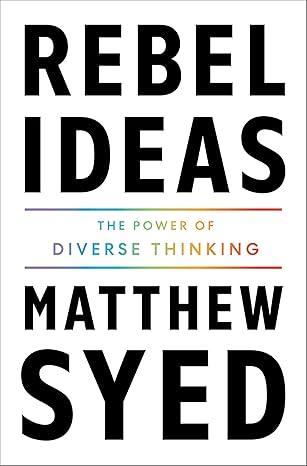
Rebel Ideas Summary
By Matthew Syed
The Power of Diverse Thinking
Summary preview
Some books try to give you better answers. This one begins somewhere more interesting. It asks whether we are even asking the right questions, and whether the way we think together is fit for a world that is growing more complex by the day. The big idea is simple, but its consequences are profound. The smartest group is not the group with the highest individual IQ. It is the group with the widest range of perspectives, experiences, tools, and ways of seeing. That is what makes a team adaptive, inventive, and resilient when reality refuses to behave. Matthew Syed wants you to look again at how success really happens. We are used to celebrating lone geniuses, heroic leaders, and brilliant experts. We love the myth of the singular mastermind who sees what no one else can see. But when you dig into how breakthroughs actually occur, whether in science, business, politics, policing, or aviation, a different picture emerges. Progress depends not just on talent, but on cognitive diversity. It depends on bringing together people who notice different things, challenge different assumptions, and carry different mental maps of the world. What makes this argument powerful is that it is not delivered as an abstract theory. It is built from stories. You move from disasters that should have been prevented to innovations that only became possible when institutions opened themselves to unfamiliar voices. You see how homogenous groups become vulnerable, not because their members lack ability, but because they share the same blind spots. You also see why diversity is not a matter of polite virtue or box ticking. It is a practical advantage. It helps us detect errors sooner, imagine alternatives faster, and cope better with uncertainty. At the same time, this is not a naive celebration of difference for its own sake. Difference can be uncomfortable. It can slow meetings down. It can create friction. It can make cooperation feel harder before it becomes better. But that discomfort is often a sign that genuine thinking is happening. When everyone agrees too quickly, it may be because no one has looked from a new angle. When institutions recruit in their own image, they may preserve harmony while quietly weakening their capacity to learn. Running through the whole book is a challenge. If the future belongs to those who can adapt, then we need to redesign our teams, schools, companies, and public institutions around the ability to think differently together. We need cultures where dissent is welcomed, where expertise is shared rather than hoarded, and where status does not suffocate truth. The aim is not conflict for its own sake. The aim is collective intelligence. That is the heart of Rebel Ideas. It is an invitation to stop worshipping sameness, and to start building environments where fresh insight can actually breathe.
Sign up to continue reading
Get access to full book summaries, audio of the summaries, and many more.
Similar Books
Books with a similar vibe—explore more like this.
The Culture Code
Daniel Coyle
The Secrets of Highly Successful Groups
4.5 (1129)28 mins

The Laws of Human Nature
Robert Greene
What affects your day-to-day life
4.4 (940)32 mins

Crucial Conversations
Kerry Patterson, Joseph Grenny, Ron McMillan, Al Switzler
Tools for Talking When Stakes Are High
4.3 (658)32 mins
Unreasonable Hospitality
Will Guidara
The Remarkable Power of Giving People More Than They Expect
4.3 (829)27 mins
The Psychology of Leadership
Sébastien Page
Timeless principles to perfect your leadership
4.0 (13)20 mins
Think Twice
Michael J. Mauboussin
Harnessing the Power of Counterintuition
3.8 (74)14 mins

The Winner Effect
Ian H. Robertson
The Science of Success and How to Use It
3.8 (26)20 mins

Effective Decision-Making
Edoardo Binda Zane
How to Make Better Decisions Under Uncertainty and Pressure
3.6 (18)25 mins
Surrender to Lead
Jessica Kriegel, Joe Terry
The Counterintuitive Approach to Driving Extraordinary Results
4.9 (7)21 mins
Next Play
Alan Stein Jr.
Improve Team Performance, Productivity, and Fulfillment
4.9 (34)26 mins