
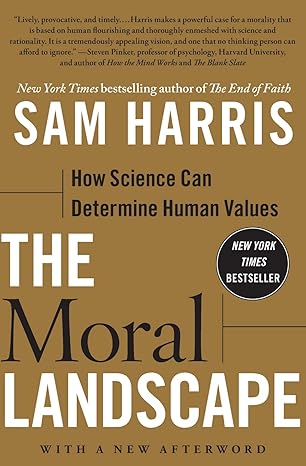
The Moral Landscape Summary
By Sam Harris
How Science Can Determine Human Values
Summary preview
Most people have been taught that morality lives in a strange fog. Facts belong to science. Values belong to culture, religion, intuition, preference, or private feeling. We are told that science can tell us how stars are born or how the brain processes vision, but it cannot tell us whether cruelty is wrong, whether justice is better than oppression, or whether one way of living is wiser than another. The whole purpose of this book is to clear that fog. It argues that right and wrong are not floating free of reality. They are tied to the well being of conscious creatures, and once we admit that, moral questions become questions about facts. That claim sounds provocative because it cuts against habits of thought that many people barely notice they have. If values are only opinions, then every moral dispute ends in a shrug. One culture praises compassion, another celebrates honor killings, and we are supposed to say that each is true for itself. If faith is the source of moral truth, then revelation settles what reason cannot. If science is restricted to what can be measured in a laboratory, then ethics is left outside the door. Sam Harris wants none of this. He insists that when suffering and flourishing are at stake, there are better and worse answers, just as there are better and worse answers in medicine, nutrition, or public health. The image that gives the book its title is simple and powerful. Imagine a landscape with many peaks and valleys. The peaks represent ways of living that allow conscious beings to thrive. The valleys represent misery, confusion, needless pain, and lives blighted by violence or ignorance. There may be many high points rather than only one perfect summit. Different cultures may discover different but equally admirable ways to live. Yet this does not mean every path is equally good. Some ways of organizing a society move people toward greater well being. Others bury them in fear and deprivation. From there the book takes on several targets at once. It challenges moral relativism, criticizes the idea that religion gives us a secure foundation for ethics, and questions the old philosophical barrier between facts and values. It also asks what modern science, especially neuroscience and psychology, can contribute to our understanding of human flourishing. Along the way it confronts hard cases involving free will, punishment, belief, tolerance, and the limits of persuasion. The result is not a dry theory but a sustained attempt to show that the deepest human concerns belong within our picture of the natural world. If we care about how people suffer, love, learn, cooperate, and find meaning, then we are already talking about matters that can be understood more clearly, argued about more honestly, and improved by better knowledge.
Sign up to continue reading
Get access to full book summaries, audio of the summaries, and many more.
Similar Books
Books with a similar vibe—explore more like this.

Sovereign Self
Acharya Shunya
Claim Your Inner Joy and Freedom with the Empowering Wisdom of the Vedas, Upanishads, and Bhagavad Gita
4.8 (114) mins

The Screwtape Letters
C.S. Lewis
Letters from a Senior to a Junior Devil
4.8 (47) mins

The Book of Five Rings
Miyamoto Musashi
A Classic Text on the Japanese Way of the Sword
4.7 (293)23 mins

Uncle Tom's Cabin
Harriet Beecher Stowe
The Problem of Slavery and Its Treatment of Human Beings
4.7 (41)25 mins

Psychological Types
Carl Jung
Collected works from the supreme theorist of the conscious
4.7 (89) mins

The Divine Comedy
Dante Alighieri
The Inferno, The Purgatorio, and The Paradiso
4.6 (457)27 mins

Wanting
Luke Burgis
The Power of Mimetic Desire in Everyday Life
4.6 (53) mins
The Power Of Meaning
Emily Esfahani Smith
Crafting a Life That Matters
4.6 (126)27 mins

The Book of Genesis
The Holy Bible
In the beginning
4.6 (12)30 mins
The Book
Alan W. Watts
On the Taboo Against Knowing Who You Are
4.5 (540)26 mins