
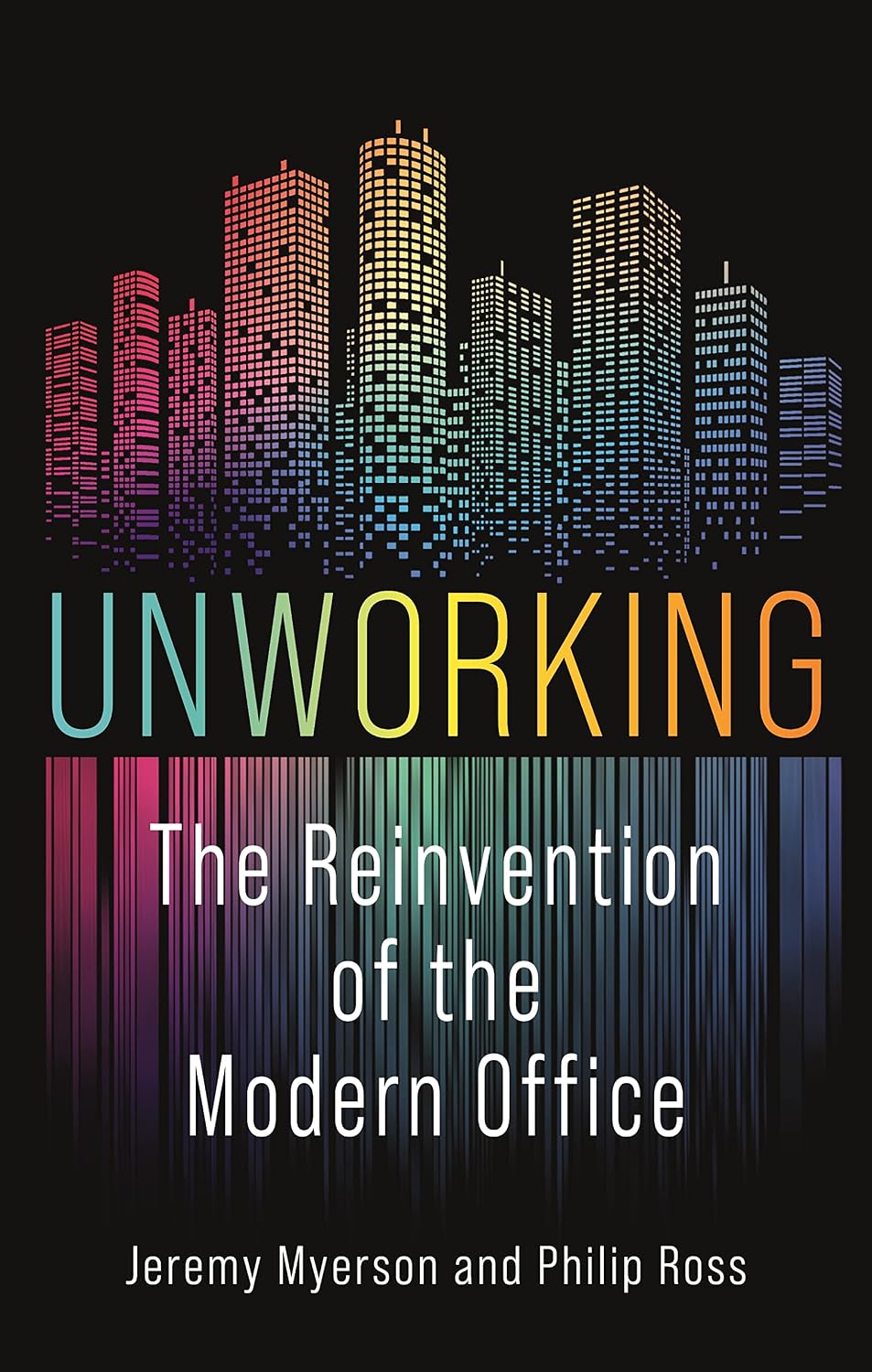
Unworking Summary
By Jeremy Myerson & Philip Ross
The Reinvention of the Modern Office
Summary preview
Work has escaped the box we built for it. That is the big shift at the heart of Unworking. For a long time, many of us were taught to think of work as a fixed activity in a fixed place, done at fixed times. You went to the office, sat at a desk, followed a schedule, and came home when the day was done. That model shaped cities, buildings, furniture, management, even our sense of identity. But the world has been moving away from that pattern for years, and this book asks us to really see what is happening when work breaks loose from old routines. Jeremy Myerson & Philip Ross explore a world in which work is no longer tied so tightly to one place, one timetable, or one kind of worker. Digital tools, mobile devices, global networks, new expectations, and changing lifestyles have all pushed us toward a more fluid reality. The office is no longer the unquestioned center of productive life. Home has become a workplace. Cafes, trains, airports, libraries, lounges, and shared work hubs have all joined the picture. Even more importantly, work itself has started to look different. It is more collaborative, more knowledge based, more mobile, and often more blended with everyday life. The book is not simply cheering for freedom and flexibility. It is asking deeper questions. If work can happen anywhere, what is the office for now. If people are always connected, what happens to rest, privacy, and focus. If companies say they value creativity and collaboration, why do so many workplaces still feel rigid, wasteful, and disconnected from how people actually behave. And if workers are becoming more autonomous, what new responsibilities fall on individuals, employers, designers, and cities. What makes this journey lively is that it is grounded in real places and real experiments. We are taken through changing offices, emerging coworking cultures, mobile work patterns, and design responses that try to support new ways of living and producing. The story is about architecture and technology, but it is just as much about culture. Behind every new workspace is a new social contract. Behind every laptop on a kitchen table is a reshaping of boundaries. Behind every lounge style meeting area is a challenge to old authority. At its core, this is a book about reimagining work from the human side. It shows that the future of work is not just about efficiency. It is about trust, choice, belonging, creativity, wellbeing, and meaning. Once work is no longer trapped inside the old office machine, we have a chance to ask a more interesting question. Not where do people fit into work, but how should work fit into people’s lives.
Sign up to continue reading
Get access to full book summaries, audio of the summaries, and many more.
Similar Books
Books with a similar vibe—explore more like this.
Day Trading Attention
Gary Vaynerchuk
Build Brand and Sales in the New Social Media World
4.5 (947)21 mins
Dotcom Secrets
Russell Brunson
The Underground Playbook for Growing Your Company Online with Sales Funnels
4.4 (836)25 mins

The Accidental Network
Rouzbeh Yassini-Fard & Stewart Schley
How a Small Company Sparked a Global Broadband Transformation
4.4 (8)26 mins
Empire of AI
Karen Hao
Dreams and Nightmares in Sam Altman's OpenAI
4.3 (459)19 mins
Problem Hunting
Brian Long
The Tech Startup Textbook
4.2 (18)22 mins
Human/Machine
Daniel Newman and Olivier Blanchard
The Future of our Partnership with Machines
4.0 (350)28 mins

Gilded Rage
Jacob Silverman
Elon Musk and the Radicalization of Silicon Valley
3.8 (6)25 mins
The AI-First Company
Ash Fontana
How to Compete and Win with Artificial Intelligence
3.8 (7)24 mins
Competing in the Age of AI
Marco Iansiti & Karim R. Lakhani
Strategy and Leadership When Algorithms and Networks Run the World
3.6 (49)13 mins

Girl Code
Cara Alwill Leyba
Secrets to Sanity and Success for the Female Entrepreneur
4.9 (4)21 mins