
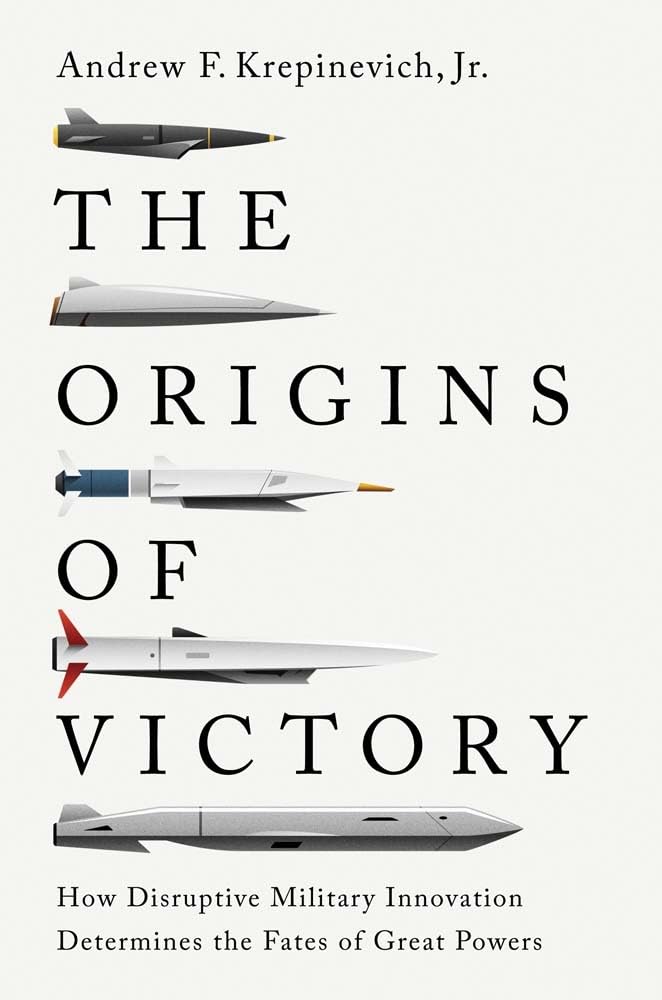
The Origins of Victory Summary
By Andrew F. Krepinevich, Jr.
How Disruptive Military Innovation Seals the Fate of Nations
Summary preview
War rarely rewards the side with the biggest army, the loudest confidence, or the finest story it tells itself before the shooting starts. It rewards the side that understands what kind of fight it is entering, what strengths really matter, and how to turn those strengths into an advantage the enemy cannot answer. That is the beating heart of The Origins of Victory. The book asks a simple but unsettling question. Why do some military organizations prepare well for future war while others march into disaster carrying old ideas that no longer fit reality? Andrew F. Krepinevich, Jr. takes us into that puzzle by looking not at battlefield heroics alone, but at the deeper work that happens before the battle. He is interested in doctrine, culture, institutions, assumptions, habits of thought, and the hard business of military innovation. Victory, as he presents it, does not begin with the first clash of arms. It begins much earlier, in the way leaders see the world, the way organizations learn or refuse to learn, and the way political aims shape military choices. The book is not content with slogans about genius generals or inevitable change. It is grounded in history and in careful comparison. Again and again, we are shown that armies, navies, and air forces do not adapt automatically, even when danger is obvious. They carry old preferences into new eras. They defend cherished identities. They misread opponents. They confuse past success with future relevance. Yet now and then, a military does something rare. It recognizes a coming shift, experiments seriously, overcomes internal resistance, and forges a new way of war that proves decisive. That makes this a book about competition in the widest sense. It is about rival powers studying one another. It is about strategic position, resources, operational concepts, and political will. It is also about timing. Some changes come too late. Some are only half complete. Some create dramatic early success but contain hidden flaws. The path to victory, then, is not a straight road. It is a contest of learning, adaptation, and execution under pressure. What gives the book its power is the way it links broad strategic ideas to concrete cases. We move through historical examples that show how military revolutions emerge, how they are recognized or missed, and how they shape wars when tested in combat. The lesson is both practical and profound. If you want to understand where victory comes from, do not look only at courage on the day of battle. Look at the years before, when institutions decide what they believe, what they practice, and what they are willing to become.
Sign up to continue reading
Get access to full book summaries, audio of the summaries, and many more.
Similar Books
Books with a similar vibe—explore more like this.
New Power
Jeremy Heimans and Henry Timms
How Power Works In Our Hyperconnected World – and How To Make It Work For You
4.6 (7)29 mins

Bedtime Biography: Yes I Can
Sammy Davis, Jr. and Jane and Burt Boyar
The Story of Sammy Davis Jr.
4.9 (7)26 mins

Nineteen Eighty-Four (1984)
George Orwell
A Dystopian Classic on the Dangers of Totalitarianism
4.9 (697)17 mins

American Lion
Jon Meacham
Andrew Jackson in the White House
4.9 (16)35 mins

Fast Forward
Melanne Verveer and Kim K. Azzarelli
How Women Can Achieve Power and Purpose
4.8 (4)29 mins

Rise Up, Women!
Diane Atkinson
The Remarkable Lives of the Suffragettes
4.8 (5)25 mins

Bedtime Biography: Edison
Edmund Morris
A look into the unknown stories of Thomas Edison's life
4.8 (36)23 mins

Lawrence in Arabia
Scott Anderson
War, Deceit, Imperial Folly and the Making of the Modern Middle East
4.8 (41)39 mins
1984
George Orwell
A Dystopian Classic on the Dangers of Totalitarianism
4.7 (1738)16 mins

Beethoven
Laura Tunbridge
A Life in Nine Pieces
4.7 (24)34 mins