
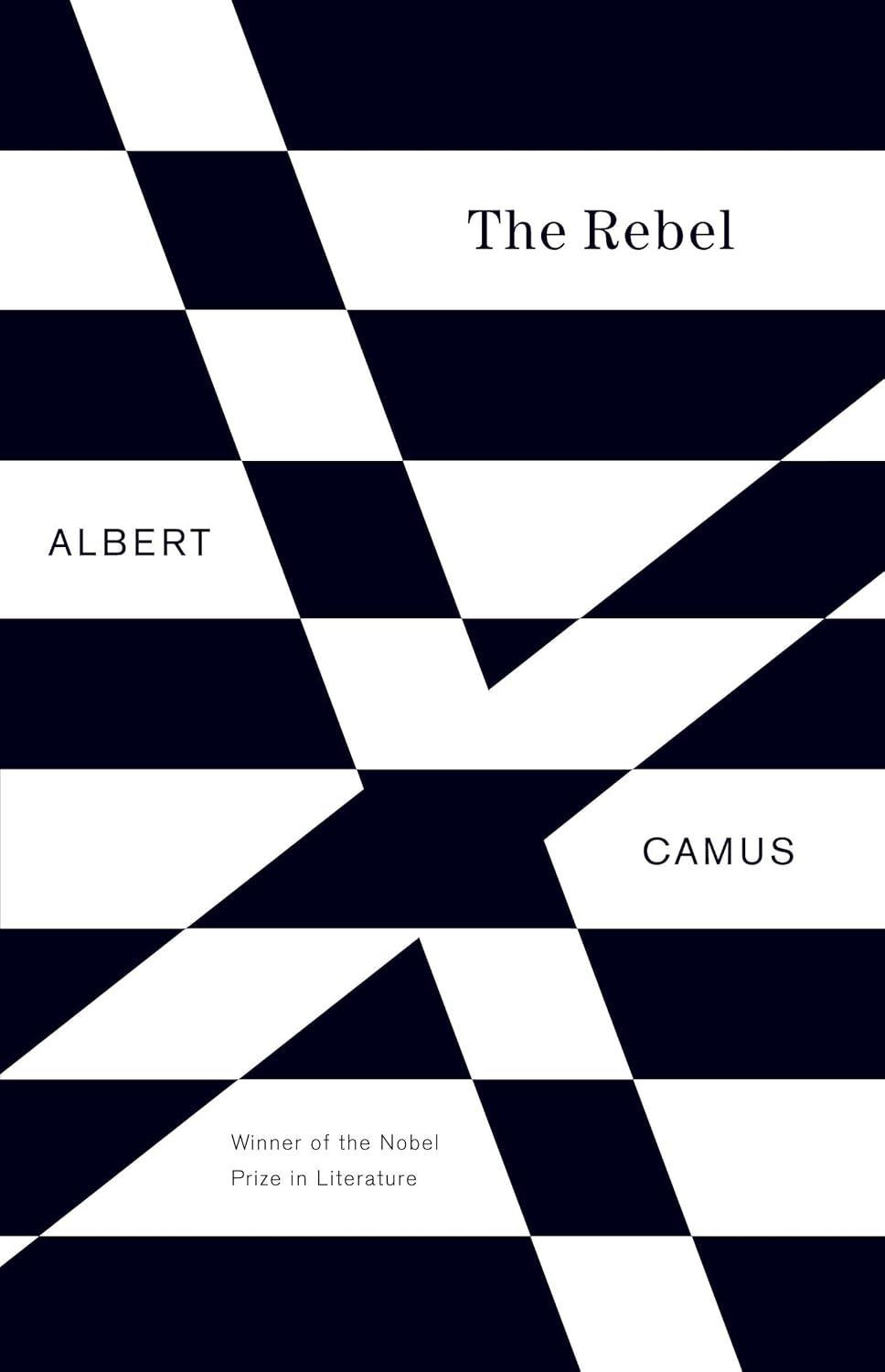
The Rebel Summary
By Albert Camus
An Essay on Man in Revolt
Summary preview
There comes a moment when a human being says no. Not a quiet no whispered in private, but a clear refusal that rises from the whole body. Someone has been pushed too far, humiliated too long, treated as a thing instead of a person. Then the refusal appears. Yet that no is never only destruction. Hidden inside it is a yes. It says that there is a line that should not be crossed, that there is something in every person that deserves respect. That is the starting point of this book. It asks what rebellion means, where it comes from, what truth it carries, and why it so often ends by betraying itself. Albert Camus begins from a simple but dangerous question. If life can seem absurd, if the world does not offer ready made meaning, why not surrender to murder, terror, or total domination? If nothing is sacred, what stops us from permitting everything? The answer he pursues is rebellion. Rebellion is not a system. It is not a cold doctrine. It is a movement of the heart and mind that rises against humiliation and injustice while still holding fast to a common human measure. The rebel does not only defend himself. He discovers, at the very moment of refusal, that his suffering is shared and that there is a bond between human beings. From there the book widens into a vast journey across ideas, literature, revolution, and history. It moves from metaphysical rebellion, where the human being rises against creation, fate, or God, to historical rebellion, where revolutions seek to remake society. Along the way, it visits the Marquis de Sade, the Romantics, the dandy, the nihilists, the terrorists of nineteenth century Russia, and the massive political religions of the modern age. It lingers over the French Revolution, over Hegel and Marx, over the dream of absolute freedom and the dream of total justice, and over the camps, tribunals, and executions that followed when those dreams forgot the living person. What makes this work so urgent is that it never treats murder as an abstract issue. It returns again and again to limits. If a rebellion begins by affirming a shared human dignity, how can it justify killing in the name of that dignity? If freedom is everything, the strong devour the weak. If justice is everything, freedom is strangled. The deepest argument of the book is that both must be held together, imperfectly, stubbornly, under the pressure of history. This is not the voice of resignation. It is the voice of measure. It asks us to reject both slavery and apocalypse. It asks us to resist injustice without becoming executioners. It asks us to live and act without appeal to final salvation through ideology. And by the end, what remains is a demanding hope, one rooted not in heaven or in future empires, but in the shared earth, the human face, and the refusal to let any cause become greater than life.
Sign up to continue reading
Get access to full book summaries, audio of the summaries, and many more.
Similar Books
Books with a similar vibe—explore more like this.
The Stranger
Albert Camus
A Philosophical Journey Into Alienation
4.6 (64)27 mins
The Four Agreements
Don Miguel Ruiz & Janet Mills
A Practical Guide to Personal Freedom
4.3 (913)21 mins
The Meaning of Life
Terry Eagleton
A Very Short Introduction
4.2 (84)23 mins
Utilitarianism
John Stuart Mill
Explore a Timeless Ethics Classic
4.8 (46)24 mins
Hamlet
William Shakespeare
A Young Prince's Tragic Descend Into Madness and Revenge
4.8 (43)28 mins
The Epic of Gilgamesh
Anonymous
A timeless tale of friendship, mortality, and the search for meaning
4.8 (34)23 mins
Othello
William Shakespeare
Love, Betrayal, and the Fall of a Hero
4.8 (14)22 mins
The Midnight Library
Matt Haig
A Fantasy Novel About the Choices That Lead to a Life Well-Lived
4.7 (4782)32 mins
Uncle Tom's Cabin
Harriet Beecher Stowe
The Problem of Slavery and Its Treatment of Human Beings
4.7 (41)25 mins

Beethoven
Laura Tunbridge
A Life in Nine Pieces
4.7 (24)34 mins