
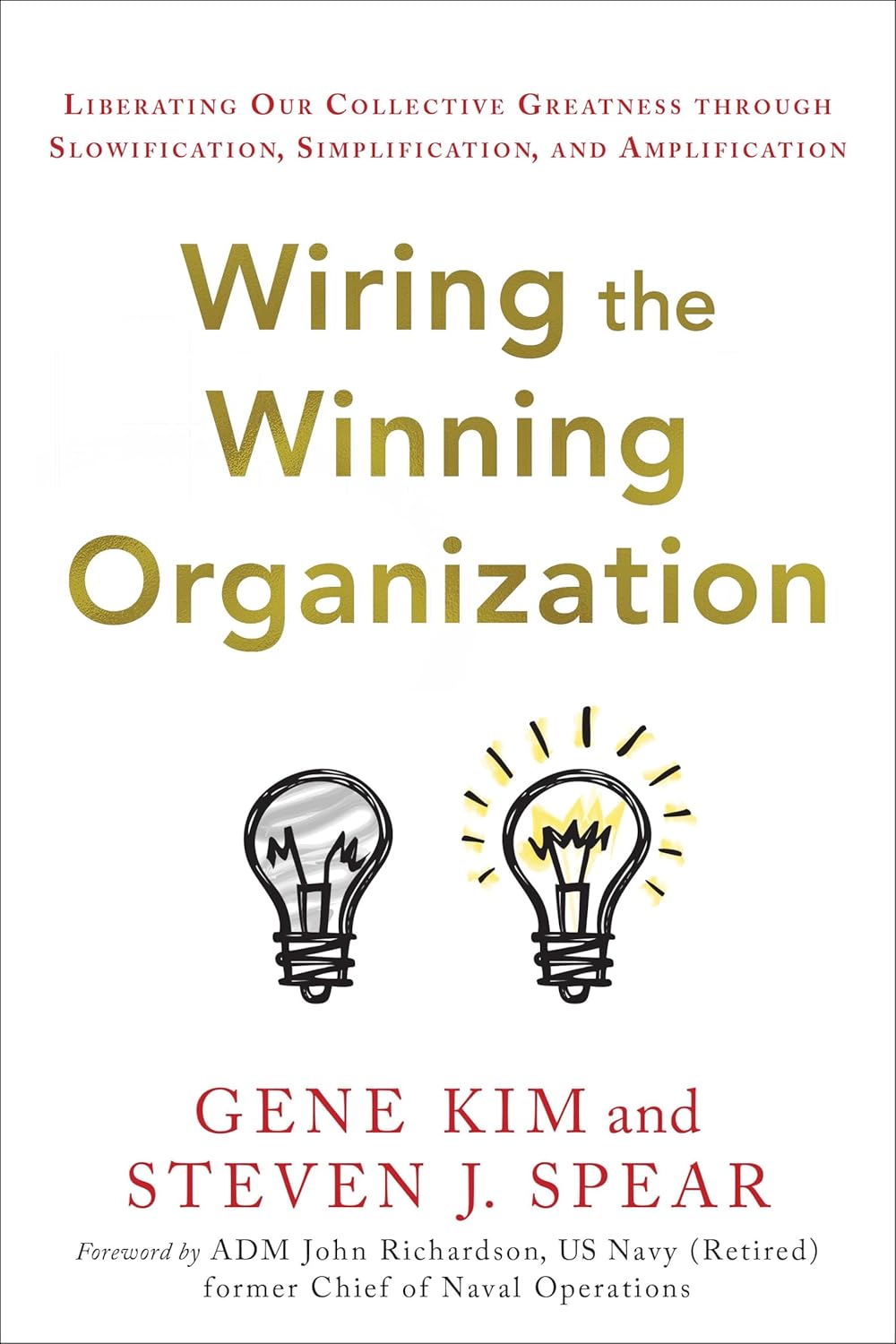
Wiring the Winning Organization Summary
By Gene Kim & Steven J. Spear
Unleashing Our Collective Greatness Through Simplification, Slowification, and Amplification
Summary preview
Most organizations say they want speed, quality, innovation, and resilience. Very few know how to get all four at once. Usually they settle for tradeoffs. Move faster and quality drops. Standardize more and creativity shrinks. Push for efficiency and people burn out. What this book argues, very clearly, is that those tradeoffs are often symptoms of poor organizational design, not laws of nature. Wiring the Winning Organization is about how leaders can build systems where ordinary people, doing everyday work, reliably produce extraordinary outcomes. It is not a book about slogans, charisma, or heroic managers saving the day. It is about the design of work itself. If you wire an organization well, people can see what is happening, solve problems where they occur, learn quickly, and improve performance without waiting for permission from distant authority. If you wire it badly, even smart and committed people get trapped in confusion, delay, and rework. Gene Kim & Steven J. Spear guide you into a way of seeing that comes from years of studying high performing systems in manufacturing, health care, technology, and other demanding settings. Again and again, the same pattern appears. The best organizations do not win because they have better posters on the wall. They win because they make it easier for people to detect problems, respond fast, and share what they learn. They create conditions where surprises become signals, where failures become fuel for learning, and where coordination does not depend on endless meetings or fragile handoffs. A big part of the book is the contrast between two worlds. In one world, work is opaque. People are overloaded. Problems travel slowly. Leaders hear good news too late and bad news even later. Improvement happens through occasional initiatives that fade before they stick. In the other world, work is visible. Responsibilities are clear. Feedback is immediate. Teams can adapt as conditions change because they are connected through simple, strong mechanisms for learning and coordination. That is what it means to wire for winning. What makes the book especially compelling is that it does not stay abstract. It brings in vivid examples from organizations that had to perform under pressure, where mistakes were costly and delay was dangerous. Through those examples, you start to see that excellence is less about individual brilliance and more about the architecture that links people, information, and action. The message is practical and demanding at the same time. If you want a better organization, do not begin by asking people to try harder. Begin by redesigning the system so the right behaviors become the natural ones.
Sign up to continue reading
Get access to full book summaries, audio of the summaries, and many more.
Similar Books
Books with a similar vibe—explore more like this.
Decision-Driven Analytics
Bart de Langhe & Stefano Puntoni
Leveraging Human Intelligence to Unlock the Power of Data
4.3 (17)25 mins
Flash Teams
Melissa Valentine & Michael Bernstein
Leading the Future of AI-Enhanced, On-Demand Work
4.3 (15)23 mins
Next Play
Alan Stein Jr.
Improve Team Performance, Productivity, and Fulfillment
4.9 (34)26 mins
How to Be a Star at Work
Robert E. Kelley
9 Breakthrough Strategies You Need to Succeed
4.6 (34)28 mins
Process!
Mike Paton, Lisa González
How Discipline and Consistency Will Set You and Your Business Free
4.6 (5)23 mins
Strategic Kaizen™
Masaaki Imai
Using Flow, Synchronization, and Leveling Assessment to Measure and Strengthen Operational Performance
4.6 (22)26 mins
Mission Ready
Lindy Elkins-Tanton
How to Build Teams That Perform Under Pressure
4.5 (6)22 mins
Tech Leadership
Andrew Swerdlow
How to Evolve from Individual Contributor to Tech Leader
4.5 (11)22 mins
The Leadership Pipeline
Ram Charan, Stephen Drotter, James L. Noel, Kent Jonasen
Developing Leaders in the Digital Age
4.5 (3)24 mins
The Adaptation Advantage
Heather E. McGowan and Chris Shipley
Let Go, Learn Fast, and Thrive in the Future of Work
4.5 (70)20 mins