
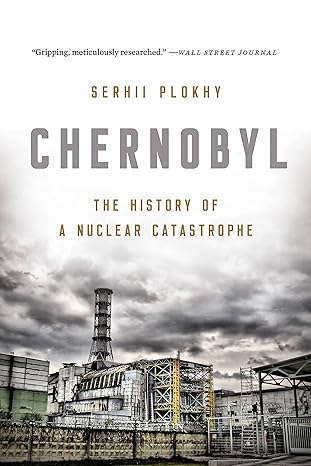
Chernobyl Summary
By Serhii Plokhy
The History of a Nuclear Catastrophe
Summary preview
Chernobyl is not just the story of a reactor explosion. It is the story of a whole system exposed in a single flash of fire. When Serhii Plokhy tells this tale, he does not begin with a simple accident report or a list of technical failures. He opens a window onto the late Soviet world, where pride in science lived side by side with fear, secrecy, and political ritual. The disaster at the Chernobyl nuclear power plant in April 1986 becomes a way to see how a giant state worked, how it lied to itself, and how ordinary people paid the price. At the center of the book is one terrible night. A safety test at Reactor Four goes wrong. Operators struggle to control a machine they do not fully understand. Design flaws hidden by bureaucracy turn danger into catastrophe. Then comes the explosion, the glowing graphite, the firefighters climbing onto a roof they believe they can save, and the invisible poison spreading through air, soil, water, bodies, and memory. But the real power of the book is that it refuses to stop at the blast itself. The accident is only the beginning. What follows is a human drama on a vast scale. Plant workers, engineers, party bosses, soldiers, pilots, miners, doctors, scientists, mothers, and children all move through these pages. Some act bravely. Some act blindly. Some cling to rules when rules no longer fit reality. Others break those rules in order to rescue strangers. The book keeps bringing us back to one hard truth. Nuclear disaster is never only nuclear. It is political, moral, environmental, and deeply personal. The story also stretches far beyond Ukraine. Radiation does not respect borders. The radioactive cloud drifts into Belarus, Russia, and much of Europe. Alarms ring in Sweden before Soviet officials publicly admit what has happened. International trust is shaken. So is domestic trust. Citizens begin to see the cost of official silence. A state that promised mastery over nature cannot even tell the truth about danger falling from the sky. By following the crisis from the control room to the Kremlin, from the streets of Pripyat to villages erased from the map, the book asks a larger question. Was Chernobyl a tragic exception, or was it the natural result of a system built on secrecy and command? The answer unfolds slowly, painfully, and with great force. What emerges is both a gripping reconstruction and a meditation on power, responsibility, and the long afterlife of catastrophe. The reactor exploded in seconds. The consequences are still unfolding.
Sign up to continue reading
Get access to full book summaries, audio of the summaries, and many more.
Similar Books
Books with a similar vibe—explore more like this.

Losing Eden
Lucy Jones
Why Our Minds Need the Wild
4.6 (641)28 mins
The Watchman's Rattle
Rebecca D. Costa
Thinking Our Way Out of Extinction
4.6 (10)22 mins

The Wide Wide Sea
Hampton Sides
The Fateful Final Voyage of Captain James Cook
4.5 (830)28 mins
The Road
Cormac McCarthy
A searing, postapocalyptic novel destined to become Cormac McCarthy’s masterpiece.
4.5 (365)24 mins

The Omnivore's Dilemma
Michael Pollan
A Natural History of Four Meals
4.5 (672)34 mins
Moby Dick
Herman Melville
One Man’s Obsession With Revenge Turns Into Self-Destruction
4.5 (1028)19 mins
The Laws of Human Nature
Robert Greene
What affects your day-to-day life
4.4 (940)32 mins
Novacene
James Lovelock
The Coming Age of Hyperintelligence
4.4 (554)25 mins
Isaac's Storm
Erik Larson
A Man, a Time, and the Deadliest Hurricane in History
4.4 (702)36 mins

All Creatures Great and Small
James Herriot
The Warm and Joyful Memoirs of the World's Most Beloved Animal Doctor
4.4 (41)27 mins