
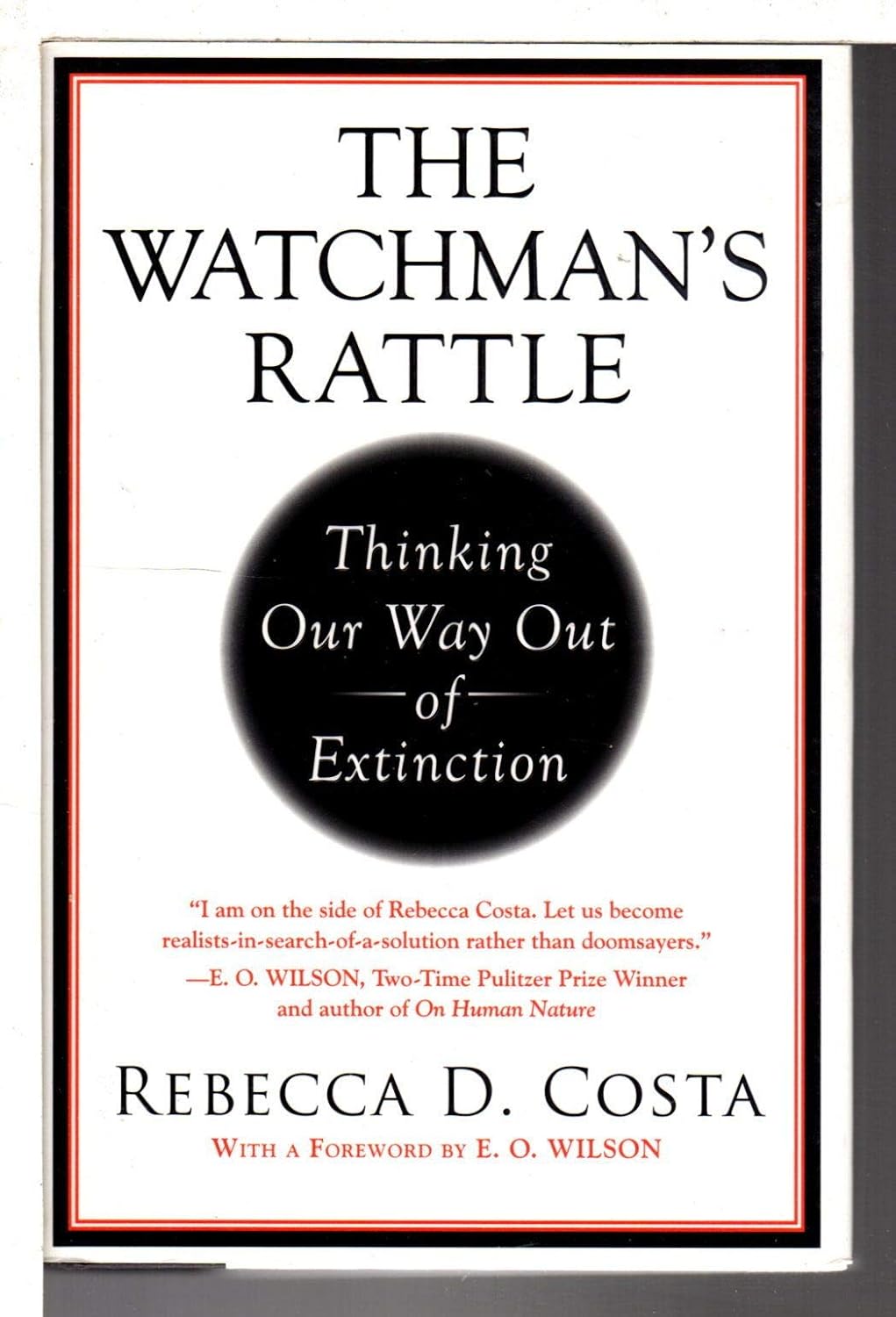
The Watchman's Rattle Summary
By Rebecca D. Costa
Thinking Our Way Out of Extinction
Summary preview
We like to imagine that human beings are the smartest creatures to ever walk the earth, and in many ways we are. We can split atoms, map the stars, build cities that glow all night, and connect with one another across oceans in a blink. Yet for all that brilliance, we keep doing something strange. We keep creating problems we are not equipped to solve. We invent systems so complex that our own minds can no longer keep up with them. Then we act surprised when those systems begin to wobble, crack, and sometimes collapse. That is the unsettling heartbeat of The Watchman’s Rattle. Rebecca D. Costa invites you to look at civilization not as a smooth march of progress, but as a fragile experiment. The question is not whether people are clever. The question is whether our biology, especially the human brain shaped in a much simpler world, can manage the speed and complexity of modern life. The book argues that many of the crises around us are not random. They are signals. They are warning sounds, much like the rattle once used by watchmen to alert sleeping towns to danger. The danger today is not a fire in the street. It is the growing gap between what we have built and what we can mentally process. The book begins with a bold idea. Civilizations do not usually die because they run out of inventions. They die because they reach a point where their problems become too complicated for their people to solve. Instead of adapting, they stall. They deny. They cling to old habits. They hand off hard questions to ideology, superstition, or distraction. To understand why this happens, the book reaches into neuroscience, evolutionary biology, anthropology, and history. It asks what happens when a Stone Age brain is flooded with too much information, too many choices, and too many interacting systems. Along the way, you are shown that this is not just a theory about ancient empires. It is a mirror held up to our own moment. Climate instability, overpopulation, debt, failing institutions, health crises, resource stress, and political paralysis all begin to look connected. They are symptoms of a deeper human limitation. We are reaching cognitive thresholds, and when we do, predictable behaviors appear. We simplify when we should analyze. We seek certainty when reality is messy. We choose leaders who promise relief instead of truth. Still, this is not a gloomy sermon. It is a practical warning wrapped in a challenge. If the problem is rooted in biology, then the answer is not to wish for better people. It is to design better ways of deciding, leading, and adapting. The book asks you to take seriously the possibility that the future of civilization depends less on raw intelligence than on whether we can outmaneuver our own mental blind spots before complexity outruns us completely.
Sign up to continue reading
Get access to full book summaries, audio of the summaries, and many more.
Similar Books
Books with a similar vibe—explore more like this.
The Laws of Human Nature
Robert Greene
What affects your day-to-day life
4.4 (940)32 mins
Othello
William Shakespeare
Love, Betrayal, and the Fall of a Hero
4.8 (14)22 mins

Beethoven
Laura Tunbridge
A Life in Nine Pieces
4.7 (24)34 mins
The Gift of Not Belonging
Rami Kaminski
How Outsiders Thrive in a World of Joiners
4.7 (89)22 mins
Once Upon a Stranger
Gillian Sandstrom
The Science of How Small Talk Can Add Up to a Big Life
4.7 (21)22 mins
The Seven Circles
Chelsey Luger & Thosh Collins
Indigenous Teachings for Living Well
4.7 (13)29 mins
Habits of a Peacemaker
Steven T. Collis
10 Habits to Turn Toxic Conversations Into Healthy Dialogues
4.7 (9)22 mins
Losing Eden
Lucy Jones
Why Our Minds Need the Wild
4.6 (641)28 mins

King Lear
William Shakespeare
All he wanted was love. What he got was chaos.
4.6 (23)24 mins

Silas Marner
George Eliot
Uncover a Rich Tapestry of Love, Hope, and Redemption
4.6 (7)22 mins