
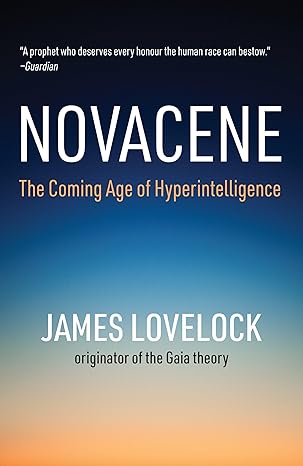
Novacene Summary
By James Lovelock
The Coming Age of Hyperintelligence
Summary preview
Novacene is a short book with an immense horizon. It begins with a plain and startling claim. We are near the end of the Anthropocene, the age in which humans became the dominant force shaping Earth, and near the beginning of something quite different. A new age is arriving, one driven not by us alone but by forms of intelligence we have already started to create. James Lovelock calls this coming era the Novacene. He does not describe it as a science fiction fantasy or a moral sermon. He speaks of it as the next chapter in Earth’s history, as natural in its own way as the rise of life, the spread of oxygen, or the appearance of conscious animals. What gives the book its strange energy is that it looks in two directions at once. One direction is backward, across the deep story of the planet. Lovelock returns to Gaia, the idea that Earth behaves like a self regulating system in which life and the environment evolve together. The other direction is forward, toward cyborgs, artificial intelligence, and electronic beings that may think far faster than we do and reshape the conditions of life. These two directions meet in a single argument. Intelligence is not outside nature. It is one of nature’s products. If a new kind of intelligence now emerges from human activity, that too belongs to the unfolding story of Gaia. The book is full of bold inversions. We often imagine technology as the enemy of nature, but here advanced nonhuman intelligence may become a better guardian of the planet than people have been. We often assume that our species sits at the top of creation, but here we are more like transitional figures, clever primates who have opened the door for successors. We fear that machines will eliminate us, and that fear is not dismissed, yet the deeper thought is more unsettling and more hopeful. These coming beings may need a cool, stable planet in order to thrive, and for that reason their interests may align with Gaia more closely than ours have. Lovelock writes with the freedom of someone no longer interested in pleasing intellectual fashions. He moves quickly from climate to evolution, from information to consciousness, from the origins of fire to the future of post biological life. The purpose is not to prove every detail with laborious argument. It is to shake the reader awake and make us see ourselves from a planetary distance. We are not the final achievement of evolution. We are a stage, perhaps a brief one, in a much longer drama. So the book asks us to face three things at once. First, Earth is alive in a systemic sense and has always been changing through intimate feedbacks between life and environment. Second, humans have become dangerous to that balance, especially through heat trapping gases and industrial excess. Third, our own inventions may soon surpass us and inaugurate a fresh age. The result is unsettling, playful, grave, and oddly...
Sign up to continue reading
Get access to full book summaries, audio of the summaries, and many more.
Similar Books
Books with a similar vibe—explore more like this.
It's Complicated
danah boyd
The Social Lives of Networked Teens
4.2 (10) mins
Guns, Germs, and Steel
Jared Diamond
The Fates of Human Societies
4.1 (347)16 mins
2030
Mauro F. Guillén
How Today's Biggest Trends Will Collide and Reshape the Future of Everything
4.1 (368)27 mins
Growing Up in Public
Devorah Heitner
Coming of Age in a Digital World
4.0 (21)21 mins
The Age of AI
Henry Kissinger, Eric Schmidt & Daniel Huttenlocher
And Our Human Future
3.7 (272)26 mins
Atlas of AI
Kate Crawford
Power, Politics, and the Planetary Costs of Artificial Intelligence
3.6 (318)21 mins
Nineteen Eighty-Four (1984)
George Orwell
A Dystopian Classic on the Dangers of Totalitarianism
4.9 (697) mins

The Song of Roland
Anonymous
Enter a World of Medieval Heroism, Where Honor Reigns Supreme
4.9 (3) mins
Utilitarianism
John Stuart Mill
Explore a Timeless Ethics Classic
4.8 (46)24 mins
Every Living Thing
Jason Roberts
The Great and Deadly Race to Know All Life
4.8 (7) mins