
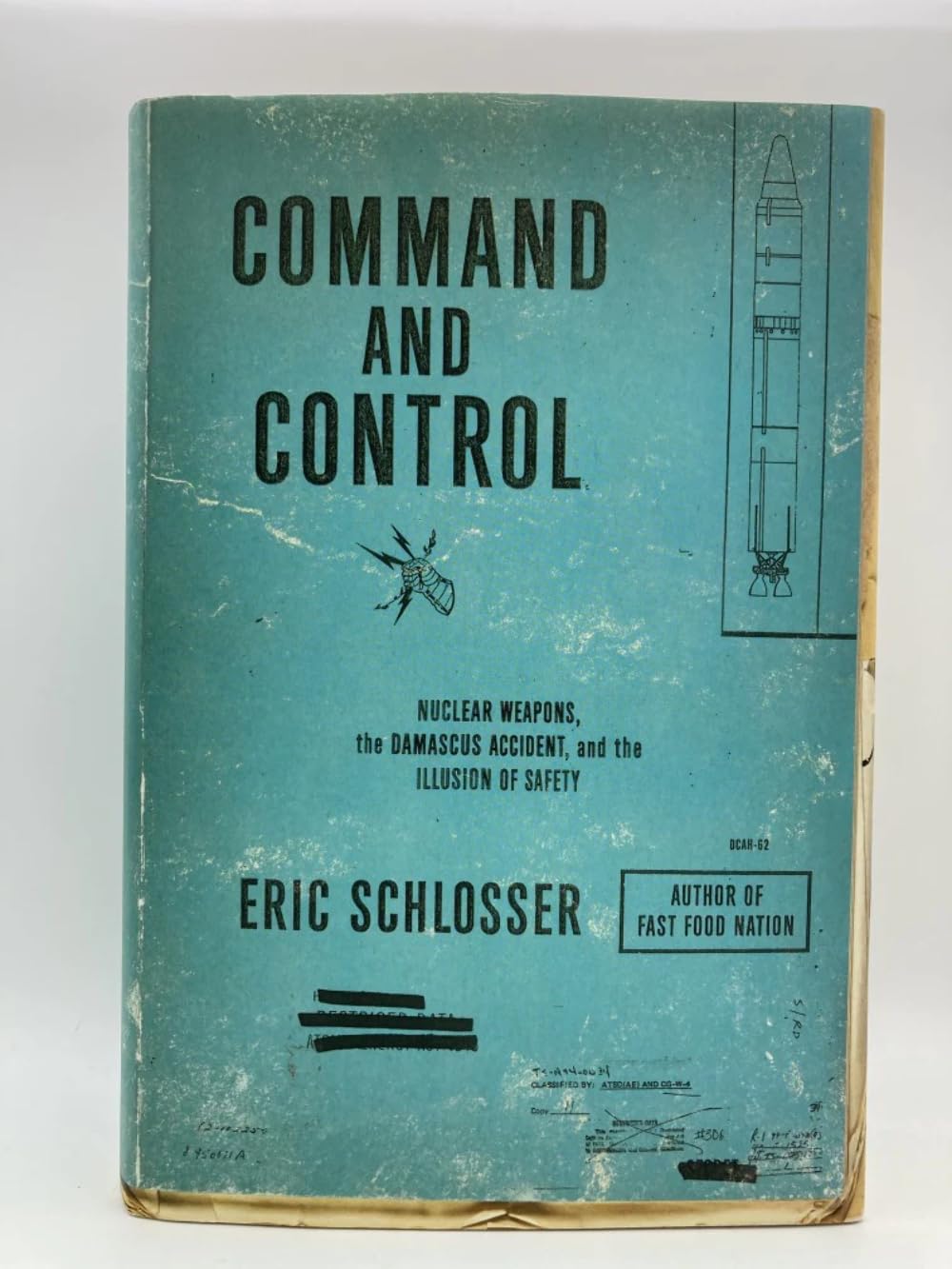
Command and Control Summary
By Eric Schlosser
Nuclear Weapons, the Damascus Accident, and the Illusion of Safety
Summary preview
Command and Control is a book about the most dangerous machines human beings have ever built, and about the ordinary people asked to live with them, guard them, design them, move them, and pray they never fail. Eric Schlosser takes what could have been a dry story of military policy and turns it into something tense, intimate, and deeply human. At the center of the book is a single night in Arkansas in 1980, when a dropped socket in a missile silo set off a chain of events that nearly led to a nuclear catastrophe. But that night is only the doorway. Once you step through it, you enter the strange hidden history of America’s nuclear arsenal, where vast power rests on fragile systems, where confidence often covers confusion, and where official promises of absolute safety are tested again and again by human error, mechanical flaws, bad luck, and bureaucratic habits. The book moves on two tracks at once. One track follows the Damascus Titan II accident almost minute by minute. Young airmen descend into a silo, perform routine maintenance, make a mistake that seems small, and then watch it grow into a national emergency. The other track stretches back through decades of the Cold War, tracing how the United States built its nuclear strategy, why it produced so many different bombs and missiles, and how commanders, scientists, engineers, and politicians created a system of astonishing complexity. As those two tracks keep crossing, a larger truth becomes impossible to ignore. Nuclear weapons are not just symbols of strength. They are physical objects made in factories, carried by trucks and planes, wired by contractors, fueled by corrosive chemicals, and handled by tired people in imperfect organizations. What gives the story its force is the gap between the official image and the lived reality. The public was told that strict procedures, advanced technology, and disciplined command structures made accidental detonation almost unthinkable. Yet the record tells another story. Fires, crashes, false alarms, lost bombs, design failures, and near misses appear not as rare exceptions but as recurring features of the system. Again and again, people improvise, conceal mistakes, cut corners, or trust devices that do not work as advertised. Again and again, chance steps in where perfect control was supposed to exist. This is also a book about language. Military planners spoke in neat abstractions like deterrence, readiness, escalation, and acceptable losses. But behind those terms stood burned flesh, poisoned air, shattered towns, and the possibility of millions dead in a few hours. The book keeps bringing the reader back from the abstract to the concrete, from doctrine to metal, fuel, and bone. By doing that, it asks a hard question that never goes away. If a system can fail in small ways over and over, why should anyone trust it not to fail in the worst possible way? That question drives everything that follows.
Sign up to continue reading
Get access to full book summaries, audio of the summaries, and many more.
Similar Books
Books with a similar vibe—explore more like this.
This Is How They Tell Me the World Ends
Nicole Perlroth
The Cyberweapons Arms Race
4.8 (64)33 mins
The Fixer
Bradley Tusk
Saving Startups from Death by Politics
4.8 (5)32 mins

How Music Got Free
Stephen Witt
What happens when an entire generation commits the same crime?
4.8 (8)36 mins

From Third World to First
Lee Kuan Yew
The Singapore Story: 1965-2000
4.7 (16)22 mins
The Bitcoin Standard
Saifedean Ammous
The Decentralized Alternative to Central Banking
4.6 (291)34 mins
Fooled by Randomness
Nassim Nicholas Taleb
The Hidden Role of Chance in Life and the Markets
4.6 (937)31 mins
Let My People Go Surfing
Yvon Chouinard
The Education of a Reluctant Businessman
4.6 (892)26 mins

Earth for All
Sandrine Dixson-Decleve, Owen Gaffney, Jayati Ghosh, Jorgen Randers, Johan Rockstrom and Per Espen Stoknes
A Survival Guide for Humanity
4.6 (14)20 mins
Fault Lines
Raghuram G. Rajan
How Hidden Fractures Still Threaten The World Economy
4.6 (9)32 mins

Money Men
Dan McCrum
A Hot Startup, A Billion Dollar Fraud, A Fight for the Truth
4.6 (15)22 mins