
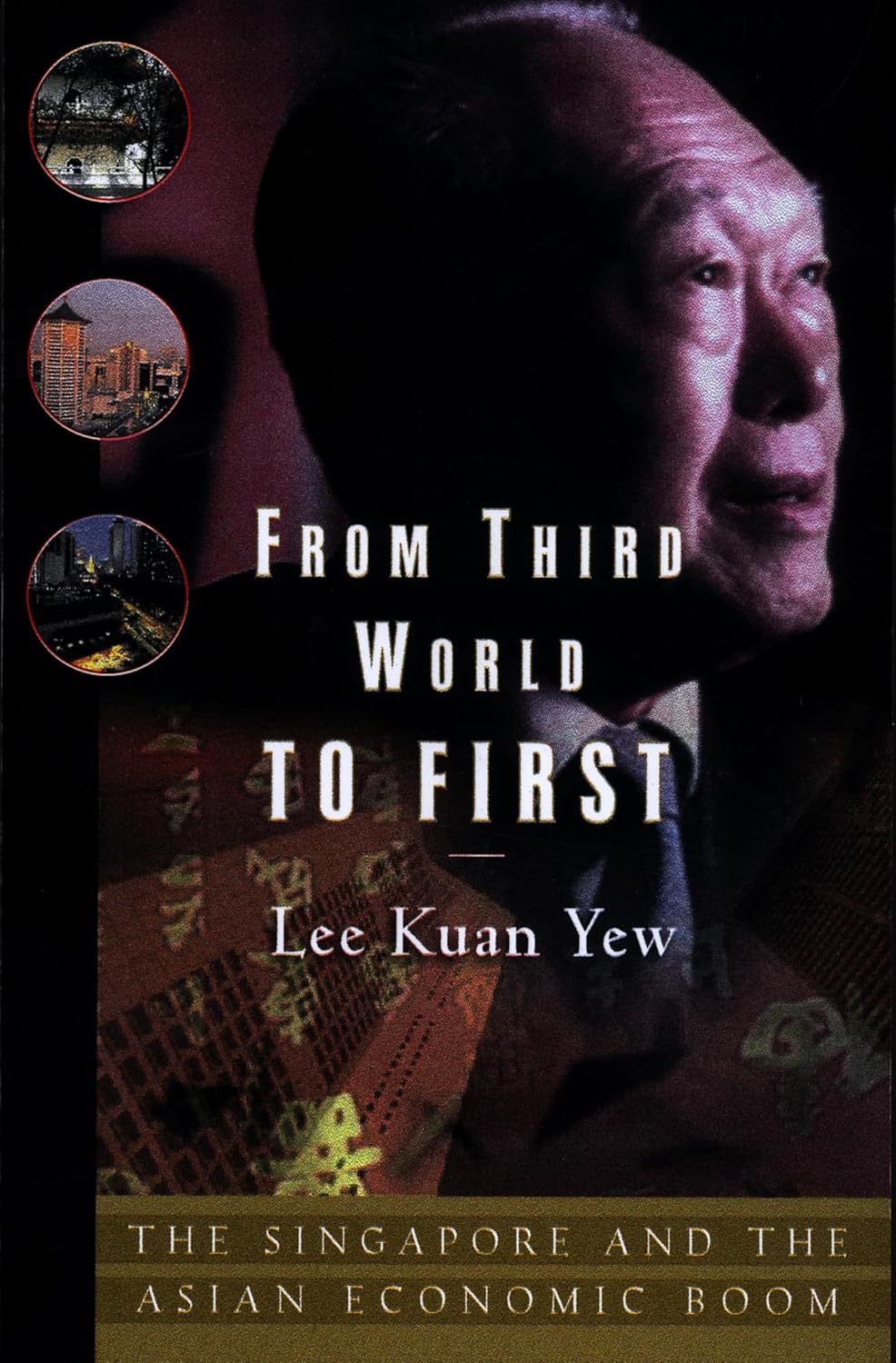
From Third World to First Summary
By Lee Kuan Yew
The Singapore Story: 1965-2000
Summary preview
This is the story of how a small, vulnerable island with no natural resources refused to accept its fate. When Singapore became independent, it was not born into comfort or security. It was poor, divided, crowded, and surrounded by larger neighbors who did not always wish it well. Many thought it could not survive on its own. It had no hinterland, no oil, no minerals, no great rivers, no broad farmlands. What it did have was a people of many races, a strategic location, and a leadership determined to turn weakness into strength. In From Third World to First, Lee Kuan Yew tells that story not as a distant historian but as a man in the middle of the struggle, making decisions under pressure, often with very little room for error. He writes about politics, yes, but never politics alone. He is always asking a harder question. How does a nation actually work? How do you keep peace among communities that do not share a common language, religion, or past? How do you create jobs where none exist? How do you build trust in government when corruption is common and cynicism easy? How do you persuade a people to endure discipline now for a better life later? The book is part memoir, part nation building manual, and part argument with the world. It follows the journey from colonial rule to self government, merger with Malaysia, painful separation, and the long effort to create a successful modern state. Along the way, it explains why clean government mattered so much, why housing became more than shelter, why education had to be practical, why industry had to welcome foreign investment, and why survival demanded military strength as well as economic growth. What gives the book its force is not only the scale of the achievement but the candor of the voice. There is pride, but also sharp realism. There is no romance about poverty, no patience for lazy ideology, and no belief that good intentions are enough. Again and again, the lesson is simple. A country advances when its leaders face facts, choose capable people, reward merit, and insist on standards. Sentiment cannot replace competence. Rhetoric cannot replace results. At the same time, this is not only a tale of steel and strategy. It is also about human habits, fears, ambitions, and loyalties. A nation is built through institutions, but institutions rest on character. The struggle for Singapore was fought in cabinet rooms, election rallies, shipyards, schools, army camps, apartment blocks, and union halls. By the end, what emerges is a clear message. Small states can thrive if they are honest about their circumstances, disciplined in their choices, and bold enough to learn from anyone who has something useful to teach.
Sign up to continue reading
Get access to full book summaries, audio of the summaries, and many more.
Similar Books
Books with a similar vibe—explore more like this.

How Music Got Free
Stephen Witt
What happens when an entire generation commits the same crime?
4.8 (8)36 mins
Cobalt Red
Siddharth Kara
How the Blood of the Congo Powers Our Lives
4.6 (4)22 mins
A Splendid Exchange
William J. Bernstein
How Trade Shaped the World
4.6 (7)30 mins
Narconomics
Tom Wainwright
How to Run a Drug Cartel
4.6 (19)29 mins
The Big Short
Michael Lewis
Inside the Doomsday Machine
4.5 (1357)36 mins
Utopia for Realists
Rutger Bregman
And How We Can Get There
4.5 (839)31 mins
Clashing over Commerce
Douglas A. Irwin
A History of US Trade Policy
4.5 (7)23 mins

A Long Way Gone
Ishmael Beah
Memoirs of a Boy Soldier
4.5 (9)27 mins
Technofeudalism
Yanis Varoufakis
What Killed Capitalism
4.5 (39)24 mins
The End of the World Is Just the Beginning
Peter Zeihan
Mapping the Collapse of Globalization
4.5 (105)25 mins