
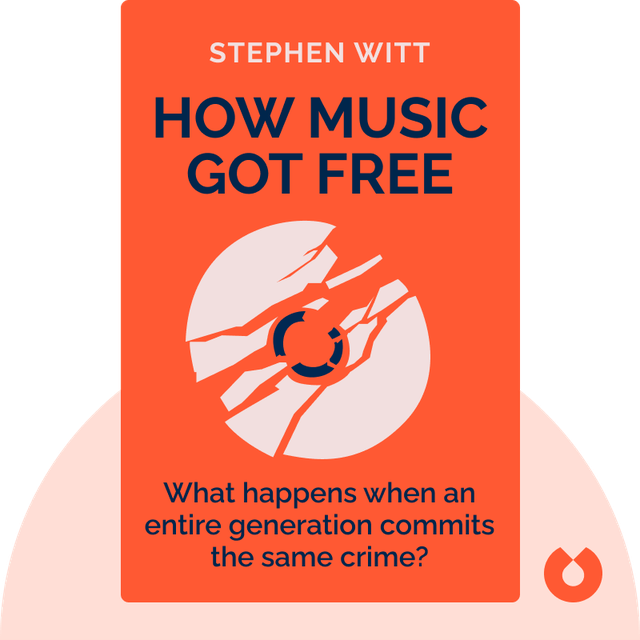
How Music Got Free Summary
By Stephen Witt
What happens when an entire generation commits the same crime?
Summary preview
There was a moment when the music business looked invincible. CDs sold for huge margins, record labels controlled who got heard, and a small group of executives could decide what the whole world would listen to next. Then, almost overnight, that world cracked open. Songs turned into files. Files turned into copies. Copies spread across the internet with almost no friction at all. A business built on scarcity ran headfirst into a technology built for abundance. That collision is the heart of How Music Got Free. The story moves through boardrooms and back alleys, through German labs and North Carolina factories, through pirate networks, internet chat rooms, and the fluorescent cubicles of the modern music industry. It is not just a story about theft, or technology, or corporate failure, though it is all of those things. It is really a story about how a set of tiny technical choices changed culture on a global scale. A compressed audio format called MP3 made songs small enough to move quickly online. A loose underground of digital pirates figured out how to rip, package, and distribute albums before they even hit stores. The major labels, rich and comfortable from the CD boom, were too slow and too arrogant to understand what was happening until billions of dollars had already vanished. What makes the book gripping is that it does not stay abstract. It gives you people. You meet Karlheinz Brandenburg, the engineer who spent years trying to make digital audio sound good enough to fool the human ear. You meet Doug Morris, one of the most powerful music executives alive, who understood hits better than almost anyone but found himself defending a business model that technology was quietly dismantling. And you meet Dell Glover, a factory worker in North Carolina who became one of the most important leakers in the history of recorded music by slipping advance CDs out of a pressing plant and into the hands of online pirate groups. That mix of invention, ambition, greed, fandom, and blind faith gives the book its charge. Stephen Witt is interested in the full chain, from the making of a song to the making of a file to the disappearance of an industry fortune. He shows how engineers wanted elegance, pirates wanted status, executives wanted control, and ordinary listeners mostly wanted convenience. Nobody set out to rewrite the rules of music all at once. But piece by piece, codec by codec, leak by leak, they did exactly that. By the time the dust settles, music has not died at all. It has simply changed owners, changed shape, and changed value. The old world sold plastic. The new one sells access, attention, and endless availability. The book tells you how that happened, and why once it began, nobody could fully stop it.
Sign up to continue reading
Get access to full book summaries, audio of the summaries, and many more.
Similar Books
Books with a similar vibe—explore more like this.
From Third World to First
Lee Kuan Yew
The Singapore Story: 1965-2000
4.7 (16)22 mins

Cobalt Red
Siddharth Kara
How the Blood of the Congo Powers Our Lives
4.6 (4)22 mins
A Splendid Exchange
William J. Bernstein
How Trade Shaped the World
4.6 (7)30 mins
Narconomics
Tom Wainwright
How to Run a Drug Cartel
4.6 (19)29 mins
The Big Short
Michael Lewis
Inside the Doomsday Machine
4.5 (1357)36 mins
Utopia for Realists
Rutger Bregman
And How We Can Get There
4.5 (839)31 mins
Clashing over Commerce
Douglas A. Irwin
A History of US Trade Policy
4.5 (7)23 mins

A Long Way Gone
Ishmael Beah
Memoirs of a Boy Soldier
4.5 (9)27 mins
Technofeudalism
Yanis Varoufakis
What Killed Capitalism
4.5 (39)24 mins

The End of the World Is Just the Beginning
Peter Zeihan
Mapping the Collapse of Globalization
4.5 (105)25 mins