
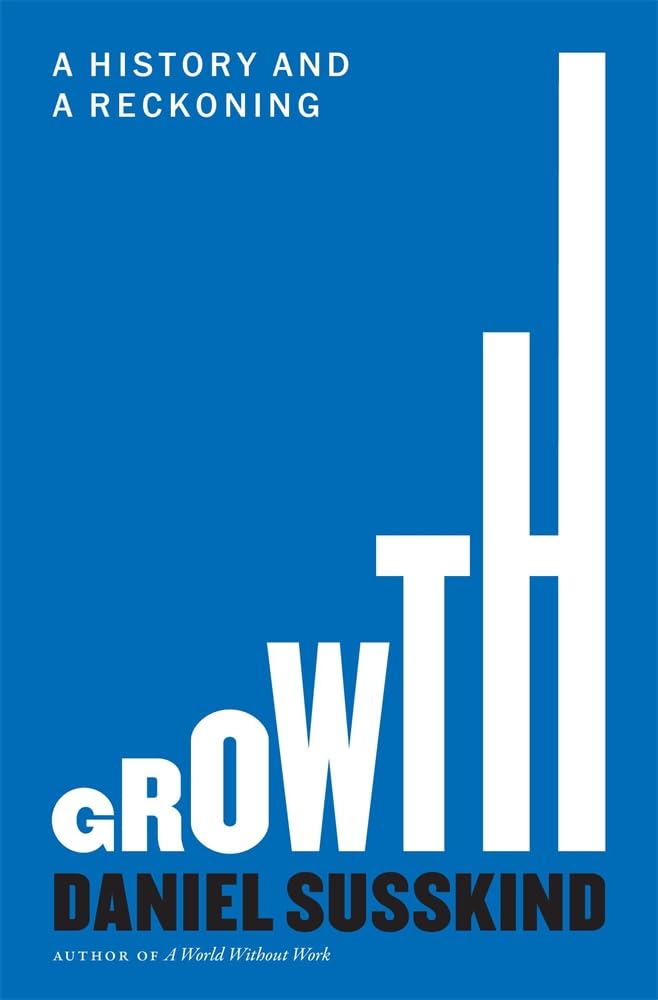
Growth Summary
By Daniel Susskind
A History and a Reckoning
Summary preview
Economic growth is one of those ideas that feels both obvious and mysterious. We can see its effects all around us in longer lives, fuller shops, warmer homes, faster travel, better medicine, and greater possibilities than earlier generations could imagine. Yet the thing itself often slips from view. We talk about growth through statistics, graphs, and quarterly reports, as if it were merely a technical matter for economists and policymakers. The deeper point of this book is that growth is far more than a line trending upward. It is one of the defining achievements of human history, a force that has transformed what it means to live, and at the same time a source of great anxiety because of what it can damage, distort, and leave behind. Daniel Susskind begins by asking us to take growth seriously in a wider, more human way. For almost all of history, life was marked by stagnation. Most people were desperately poor. Progress was fragile. Then something extraordinary happened. Economies began to expand in a sustained way, and once they did, living standards changed at a speed no earlier age had known. That shift did not solve every problem, but it altered the horizon of political and moral life. If societies can grow richer, they can do more for their citizens. They can feed more people, educate more children, treat more illness, and give individuals more room to pursue the lives they value. But the story does not end in celebration. Growth has become harder to think about because it carries a double meaning. On one hand, it is the engine behind prosperity. On the other, it can intensify inequality, unsettle communities, strain democratic institutions, and put enormous pressure on the natural world. We are pulled in two directions at once. We want the benefits that growth has historically brought, yet we worry about whether the old model can continue, whether it should continue, and who really gains when it does. What follows is an effort to untangle that dilemma. The book asks where growth comes from, why it matters, why it is now contested, and how we might preserve its benefits without ignoring its costs. It ranges widely through history, economics, politics, technology, and environmental debate, but always with a clear aim. The aim is to help us see that the future of growth is not a dry policy issue tucked away in a ministry or central bank. It is a question about the kind of society we hope to build. If growth has shaped the modern world more than almost anything else, then deciding how to think about it is really a way of deciding how we want to live.
Sign up to continue reading
Get access to full book summaries, audio of the summaries, and many more.
Similar Books
Books with a similar vibe—explore more like this.

Cobalt Red
Siddharth Kara
How the Blood of the Congo Powers Our Lives
4.6 (4)22 mins
Technofeudalism
Yanis Varoufakis
What Killed Capitalism
4.5 (39)24 mins
Chokepoints
Edward Fishman
How the Global Economy Became a Weapon of War
4.3 (16)22 mins

Streaming Wars
Charlotte Henry
How Getting Everything We Wanted Changed Entertainment Forever
4.3 (3)23 mins
2030
Mauro F. Guillén
How Today's Biggest Trends Will Collide and Reshape the Future of Everything
4.1 (368)27 mins
Power and Progress
Daron Acemoglu & Simon Johnson
Our Thousand-Year Struggle Over Technology and Prosperity
4.0 (389)24 mins
Taming Silicon Valley
Gary F. Marcus
How We Can Ensure That AI Works for Us
4.0 (11)23 mins
Too Smart
Jathan Sadowski
How Digital Capitalism Is Taking Over the World
4.0 (46)25 mins
The Technology Trap
Carl Benedikt Frey
Capital, Labor, and Power in the Age of Automation
3.9 (734)18 mins
The Age of Extraction
Tim Wu
How Tech Platforms Conquered the Economy and Threaten Our Future Prosperity
3.9 (8)25 mins