
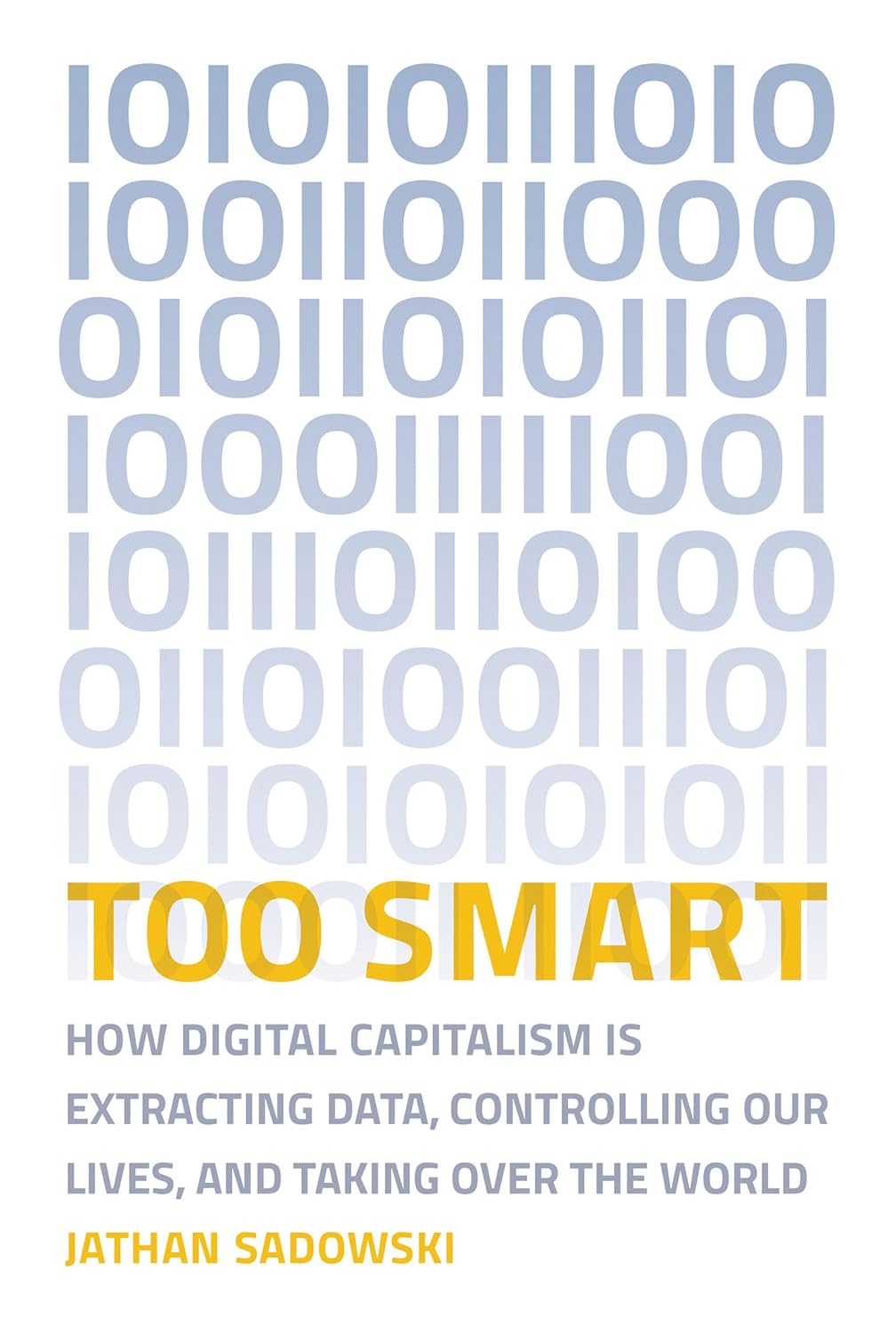
Too Smart Summary
By Jathan Sadowski
How Digital Capitalism Is Taking Over the World
Summary preview
Smart things are supposed to make life easier. That is the sales pitch humming behind every connected speaker, every fitness tracker, every camera that watches the porch, every thermostat that learns your habits, and every city sensor tucked into the background of daily life. The promise sounds simple and even kind. More convenience. More efficiency. More safety. Less waste. Less friction. A smoother world. But this book asks you to stop and look again at what kind of world is actually being built when ordinary objects are turned into data machines. Once you do, the glow of smartness starts to look a lot harsher. Jathan Sadowski pulls apart the mythology of smart technology and shows that these devices are not just helpful tools sprinkled around an otherwise normal society. They are pieces of a much bigger system. They sense, record, transmit, analyze, and act. They collect information about what we do, when we do it, how we move, what we want, and what our routines reveal. And they do this not as a side effect but as a business model. The smart home, the smart office, the smart city, the smart body, all of them become sites where life is captured and converted into data that can be used for profit, prediction, and control. What makes the argument so powerful is that it is not just about gadgets. It is about power. It is about who gets to define problems and sell the solutions. It is about how corporations and governments use the language of innovation to slip surveillance and automation deeper into the fabric of everyday life. It is about how convenience becomes a way of training us to accept constant monitoring. It is about how the things around us start making decisions, setting limits, nudging behavior, and reshaping social relations while pretending to be neutral, objective, and inevitable. The book moves across homes, workplaces, public infrastructure, and bodies to show how smart systems spread. Along the way, it digs into the politics hidden inside design, the labor hidden behind automation, and the economic logic driving all this connection. For instance, a smart speaker is not just a speaker. A delivery algorithm is not just software. A connected city platform is not just an upgrade. Each one is part of an infrastructure that extracts value by making more of life measurable and manageable. What emerges is a sharp but lively warning. We are told that smart technologies are the future. The deeper point here is that they are also a way of governing the present. They do not merely respond to our needs. They shape them. They do not simply know us. They organize us. And if we want a different future, we have to stop treating smartness as magic and start seeing it for what it is, a political and economic project built into the objects all around us.
Sign up to continue reading
Get access to full book summaries, audio of the summaries, and many more.
Similar Books
Books with a similar vibe—explore more like this.

Cobalt Red
Siddharth Kara
How the Blood of the Congo Powers Our Lives
4.6 (4)22 mins

Technofeudalism
Yanis Varoufakis
What Killed Capitalism
4.5 (39)24 mins
Growth
Daniel Susskind
A History and a Reckoning
4.3 (11)23 mins

Chokepoints
Edward Fishman
How the Global Economy Became a Weapon of War
4.3 (16)22 mins

Streaming Wars
Charlotte Henry
How Getting Everything We Wanted Changed Entertainment Forever
4.3 (3)23 mins

2030
Mauro F. Guillén
How Today's Biggest Trends Will Collide and Reshape the Future of Everything
4.1 (368)27 mins
Power and Progress
Daron Acemoglu & Simon Johnson
Our Thousand-Year Struggle Over Technology and Prosperity
4.0 (389)24 mins
Taming Silicon Valley
Gary F. Marcus
How We Can Ensure That AI Works for Us
4.0 (11)23 mins
The Technology Trap
Carl Benedikt Frey
Capital, Labor, and Power in the Age of Automation
3.9 (734)18 mins

The Age of Extraction
Tim Wu
How Tech Platforms Conquered the Economy and Threaten Our Future Prosperity
3.9 (8)25 mins