
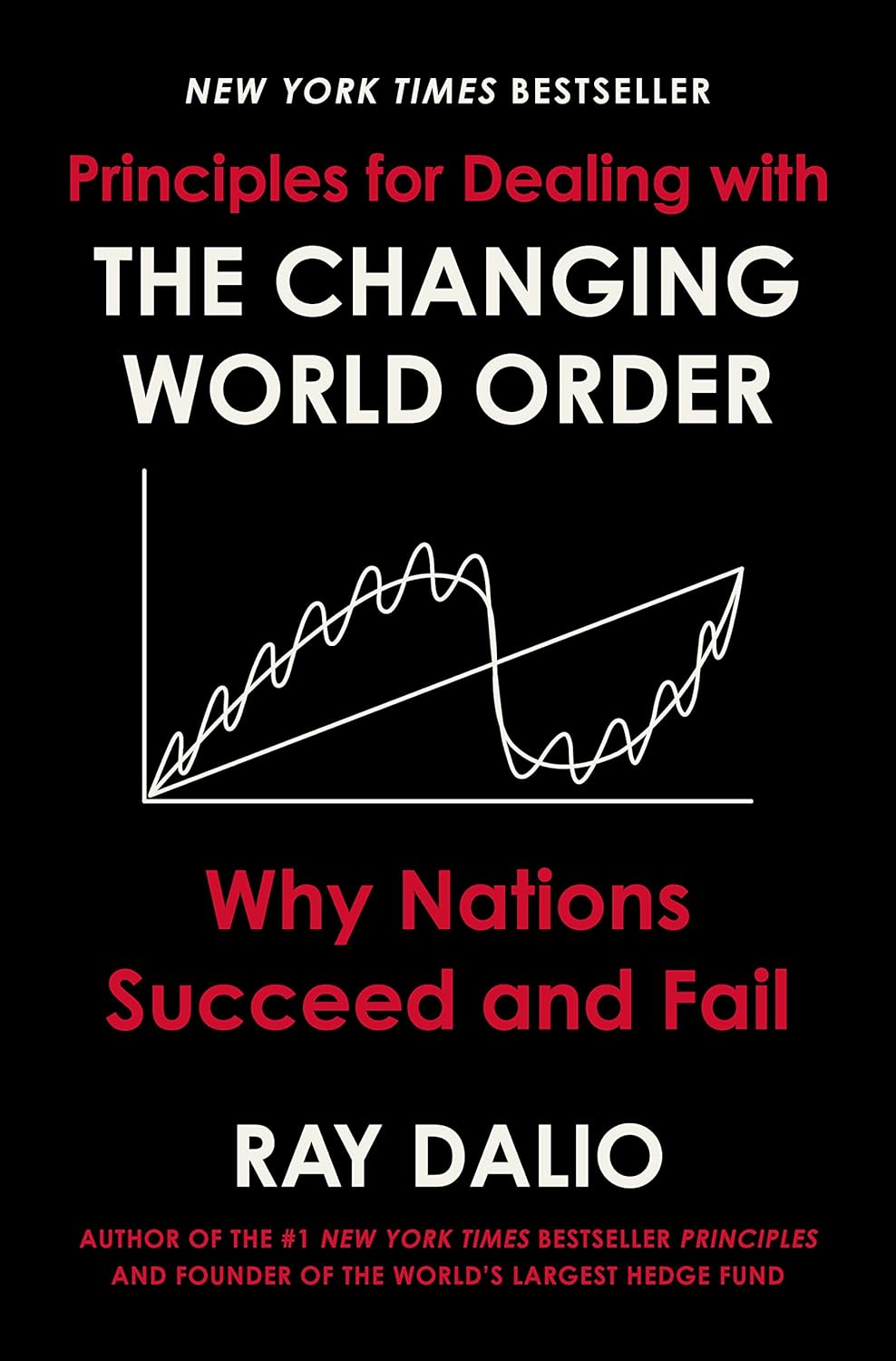
Principles For Dealing With the Changing World Order Summary
By Ray Dalio
Why Nations Succeed and Fail
Summary preview
Most people look at what is happening around them and see a stream of separate events. A market rise here, a war there, an election, a debt problem, a new technology, a shift in power between countries. What this book asks you to do is step back and see the pattern. The big claim is simple but powerful. History moves in cycles. Countries, like people and companies, go through periods of building, flourishing, overreaching, and declining. If you can understand those repeating patterns, you can deal with the future more intelligently. That is the purpose of this book. It is not mainly about predicting exact dates or trying to sound clever after the fact. It is about building a practical template for understanding how the world order changes. The heart of the idea is that wealth, power, and influence do not stay in one place forever. Over long stretches of time, empires rise because they become productive, educated, innovative, and strong. Then, often because success plants the seeds of excess, they become indebted, divided, and less competitive. Eventually a new power rises to challenge the old one, and the world order changes. Ray Dalio came to this view not as a historian sitting in a library for its own sake, but as an investor and decision maker who needed to understand what was happening when familiar rules stopped working. He was especially struck by moments like 2008, when debt cycles and money printing reshaped economies, and by the growing rivalry between the United States and China, which felt less like ordinary politics and more like a recurring chapter in a very old story. That pushed him to study hundreds of years of history, especially the Dutch, British, and American empires, and to compare them with the rising Chinese power. What follows is both broad and concrete. You get a framework for how internal forces such as education, innovation, debt, inequality, values, and political conflict shape a nation’s health. You also get a way to think about external forces such as trade competition, military power, reserve currencies, and war. The book keeps returning to one crucial point. These things are connected. Financial bubbles are tied to political conflict. Political conflict is tied to inequality and values gaps. International rivalry is tied to economic strength, technological leadership, and the ability to borrow cheaply. The result is a map of how big shifts happen. It helps explain why dominant powers often assume their position is natural and permanent right before it starts slipping. It helps explain why rising powers often seem chaotic, rough, or underestimated right before they become central. And it encourages you to look at current events with less emotion and more perspective. As one of the book’s guiding ideas puts it, you need to see things from above the immediate drama. If you can understand the archetypal cycle, you have a better chance of dealing well with the changing world order.
Sign up to continue reading
Get access to full book summaries, audio of the summaries, and many more.
Similar Books
Books with a similar vibe—explore more like this.
The Big Short
Michael Lewis
Inside the Doomsday Machine
4.5 (1357)36 mins
The Land Trap
Mike Bird
A New History of the World's Oldest Asset
4.5 (15)23 mins
The Almightier
Paul Vigna
How Money Became God, Greed Became Virtue, and Debt Became Sin
4.5 (16)27 mins

Financial Feminist
Tori Dunlap
Overcome the Patriarchy's Bullsh*t to Master Your Money and Build a Life You Love
4.2 (85)24 mins
The Fixer
Bradley Tusk
Saving Startups from Death by Politics
4.8 (5)32 mins
How Music Got Free
Stephen Witt
What happens when an entire generation commits the same crime?
4.8 (8)36 mins
From Third World to First
Lee Kuan Yew
The Singapore Story: 1965-2000
4.7 (16)22 mins
The Bitcoin Standard
Saifedean Ammous
The Decentralized Alternative to Central Banking
4.6 (291)34 mins

Cobalt Red
Siddharth Kara
How the Blood of the Congo Powers Our Lives
4.6 (4)22 mins
A Splendid Exchange
William J. Bernstein
How Trade Shaped the World
4.6 (7)30 mins