
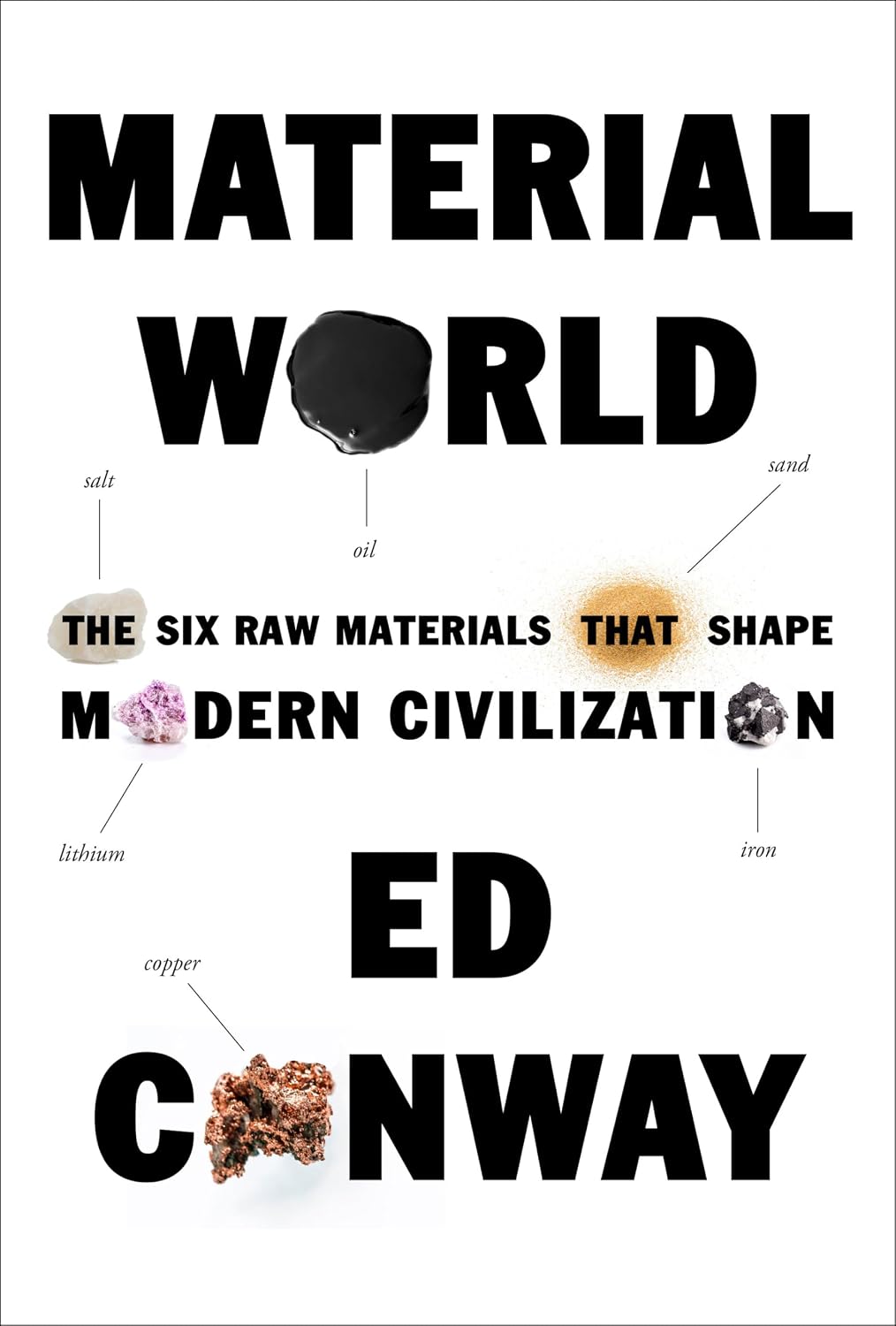
Material World Summary
By Ed Conway
The Six Raw Materials That Shape Modern Civilization
Summary preview
Look around you for a moment. The phone in your hand, the window by your side, the wires in your walls, the concrete under your feet, the food on your plate, even the clean water that arrives as if by magic. We live in a world that feels digital, weightless, frictionless. We talk about apps, clouds, data, finance, artificial intelligence. We behave as if the modern economy is made of ideas alone. But that is an illusion. Scratch the shiny surface of everyday life and you hit something older, tougher, and much less glamorous. You hit the material world. That is the great journey at the heart of this book. It is an attempt to see the physical foundations of civilization again, to notice the hidden substances that make modern life possible, and to understand the systems, places, and people behind them. Ed Conway takes you to mines, deserts, factories, refineries, salt flats, forests, and farms, not to admire industrial scenery but to reveal a simple truth. We have not escaped matter. If anything, our dependence on it has grown deeper even while it has become less visible. The book is built around a handful of materials and elemental goods that seem ordinary precisely because they are so common. Sand, salt, iron, copper, oil, lithium. Each one unlocks a different part of the story of human progress. Each one also carries a warning. The things we rely on most are often the things we think about least. And because we do not see them clearly, we misunderstand both the strengths and fragilities of the world we have built. What makes this account so gripping is that it never stays abstract for long. You are not given a neat theory and left there. You are taken to the places where these materials are dug up, cooked, pumped, melted, purified, or transformed. You meet landscapes stripped open to feed cities an ocean away. You see how geopolitics, technology, war, climate, trade, and even taste are tangled up with the most basic substances on Earth. For example, a grain of sand can tell a story about skyscrapers and microchips. A pinch of salt can open up a history of preservation, empire, chemistry, and energy. A strip of copper can lead straight into the future of electrification. Running through everything is a challenge to modern complacency. We like to imagine that complexity has liberated us from limits, that innovation can float above geology, that cleaner technologies somehow need fewer raw materials. The opposite is often true. The greener world we say we want may require even more mining, more processing, more concentration of supply, and more hard choices about who pays the human and environmental cost. So this is a book about what the world is really made of, and about what that means for power, prosperity, and survival. It asks you to notice what has been hidden in plain sight. Once you do, the world looks different. Solid again. Heavy again. Real again.
Sign up to continue reading
Get access to full book summaries, audio of the summaries, and many more.
Similar Books
Books with a similar vibe—explore more like this.

To Dye For
Alden Wicker
How Toxic Fashion Is Making Us Sick
4.4 (14) mins
Value(s)
Mark Carney
Building a Better World for All
4.3 (24)22 mins
2030
Mauro F. Guillén
How Today's Biggest Trends Will Collide and Reshape the Future of Everything
4.1 (368)27 mins

How Music Got Free
Stephen Witt
What happens when an entire generation commits the same crime?
4.8 (8)36 mins
From Third World to First
Lee Kuan Yew
The Singapore Story: 1965-2000
4.7 (16)22 mins
Losing Eden
Lucy Jones
Why Our Minds Need the Wild
4.6 (641)28 mins
Earth for All
Sandrine Dixson-Decleve, Owen Gaffney, Jayati Ghosh, Jorgen Randers, Johan Rockstrom and Per Espen Stoknes
A Survival Guide for Humanity
4.6 (14) mins
The Watchman's Rattle
Rebecca D. Costa
Thinking Our Way Out of Extinction
4.6 (10)22 mins
Cobalt Red
Siddharth Kara
How the Blood of the Congo Powers Our Lives
4.6 (4)22 mins
A Splendid Exchange
William J. Bernstein
How Trade Shaped the World
4.6 (7)30 mins